The SEQ Development Brief
Swish Development
Queensland’s run above the national trend broke in May
Queensland dwelling approvals fell 8.8% in May on a seasonally adjusted basis, the Australian Bureau of Statistics reported on 1 July. It is a sharp reversal. For months Queensland ran against the national grain, posting small gains while the national count fell, and in April its private-sector house approvals hit their highest level since July 2021. May undid that. Private-sector house approvals in the state fell 3.6%, and the total dropped almost 9%.
The national picture was softer but steadier. Total dwellings approved fell 1.1% to 17,019, held up by a 2.8% rise in private-sector houses and pulled down by a 10.4% fall in approvals for private dwellings excluding houses, the apartment and townhouse category. The split inside the national number is the story: detached houses are holding up nationally while attached product fell hard in May.
For a small operator the read runs two ways. A contracting approvals pipeline into a rental market under 1% vacancy keeps completions behind demand, which holds the floor under rents. But the Queensland fall is concentrated in the detached-house end that carries the greenfield and house-and-land segment, the part of the market most exposed to the rate path and to the first home grant that has just been cut. The infill and small-lot product that sells to owner-occupiers off the plan is not where the May drop landed hardest. (Source: ABS Building Approvals, May 2026, released 1 July 2026.)
National home values fell in June, and Brisbane’s growth is fading
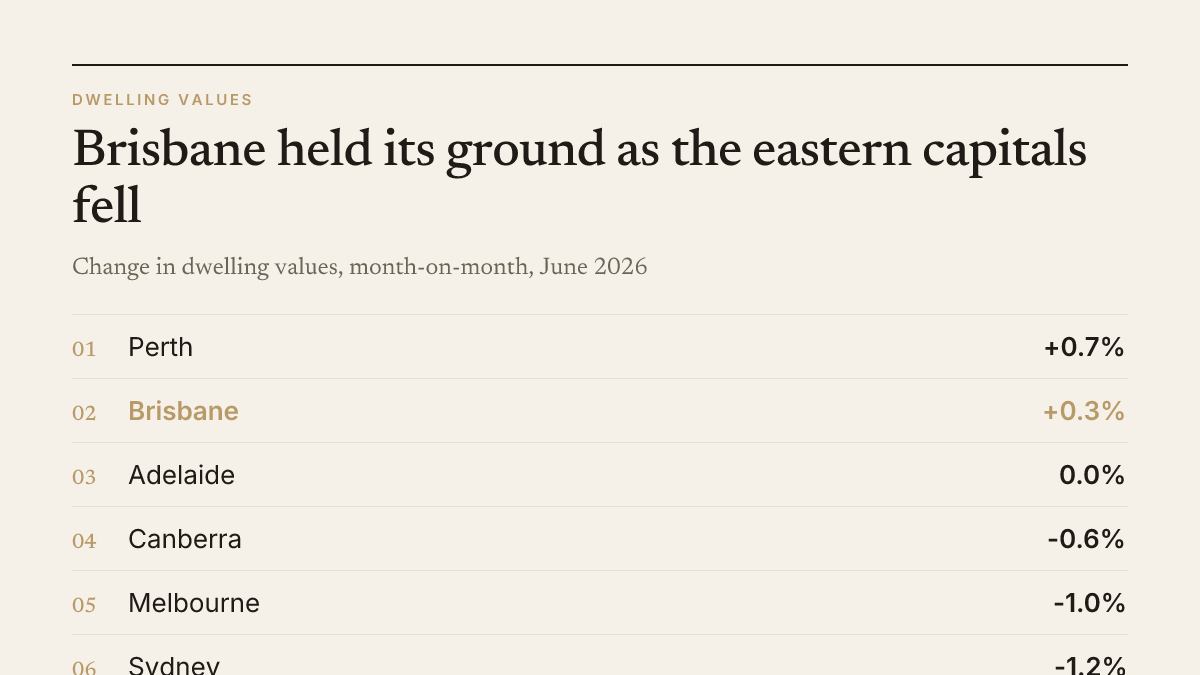
Cotality’s national Home Value Index fell 0.4% in June, its steepest monthly decline in three and a half years, the firm reported on 1 July. Sydney led the falls at 1.2% and Melbourne at 1.0%. The boom that ran through 2025 has turned, with higher borrowing costs and softer demand doing the work.
Brisbane held up, but barely by its own recent standard. Values rose 0.3% for the month, down from 0.9% in May. Brisbane is now among the last capitals still rising, which makes it a relative-strength market by default rather than by momentum. Over the year to May, Brisbane values were up 19.1%, with the median dwelling at $1,126,149 (Cotality). That annual figure is a rear-view number; the monthly trend is where the risk now sits.
The read for feasibilities is a reset, not an alarm. A model resting on continued high-single or double-digit Brisbane capital growth is pricing the wrong slope. The market has moved from broad appreciation to a selective one, where the values still holding are doing so on stock and location rather than on a rising tide. Presale assumptions and end-value estimates written in the first half of the year are worth re-testing against a flat-to-modest second half. (Sources: Cotality Home Value Index, June 2026, released 1 July 2026; Cotality HVI May 2026 for the annual and median figures.)
The two prints above set the data week, both released 1 July. Underneath them the rate and rental picture held where it was. The Reserve Bank’s cash rate is 4.35%, held on 17 June, its first pause after three hikes earlier in the year, with the next decision due in August. There is no July meeting, so nothing between now and then moves the rate feasibilities are written against.
Rents stayed tight. SQM Research’s most recent vacancy print is May, released 15 June: the national rate held at 1.2% and Brisbane sat at 0.9%, with Brisbane combined rents up 9.1% over the year. The June vacancy figures release in mid-July, after this issue. The auction market stayed weak, with combined-capitals clearance holding below 50%. The last clearance rate confirmed to a Cotality release was 47.4% for the weekend ending 21 June, and June’s value falls are the price catching up to that.
The through-line across the table is a market cooling on the supply and the demand side at once. Approvals down, values turning, clearance under 50%, and a cash rate that does not move until at least August.
Queensland has rejoined the pack.
The state spent months approving homes while the national count fell, and in April its house approvals were the strongest since July 2021. May erased the gap, with total approvals down 8.8% and houses down 3.6%. The outperformance that underwrote a lot of Queensland feasibility optimism was a lead, not a structural gap, and it has closed.
The downturn reached the price data.
Last month the sub-50% auction clearance read as sentiment running ahead of price. June’s 0.4% national value fall, the steepest in three and a half years, is the price following through. Brisbane at 0.3% has not turned, but the direction of the national series is now unambiguous, and Brisbane rarely stays disconnected from it for long.
Brisbane’s relative strength cuts both ways.
With Sydney down 1.2% and Melbourne down 1.0% in June, Brisbane’s 0.3% makes it a top performer without doing anything, which is how capital overshoots a market just as its local momentum fades. The 19.1% annual figure to May is the number buyers will quote and the one least useful for pricing a project that settles in 2027. Anchor end values to the monthly trend, not the annual headline.
The grant cut landed into a falling market.
The $30,000 First Home Owner Grant for new builds reverted to $15,000 for contracts signed from 1 July, and the date-bound demand that pulled contracts forward in late June is now spent. The same house-and-land product is $15,000 harder to move at the same price, into a month where approvals fell and values turned. Owner-occupier infill sold off the plan is less exposed than grant-dependent house-and-land stock.
A shrinking pipeline still floors rents.
Queensland approvals down almost 9% and national approvals down 1.1%, into a rental market under 1% vacancy, keeps completions behind demand through 2027. The capital-growth case is wobbling; the rent-growth case is not. Small-multi and build-to-rent feasibilities that lean on rent rather than resale are the more resilient structure in this turn.
The awards went to the manage-the-asset layer, not the find-the-site layer
Proptech Australia handed out its 2026 awards in Sydney on 3 July, and the pattern in the winners is worth a developer’s attention. Asseti, an AI platform that monitors building and asset condition from drone imagery and digital replicas, was the biggest winner of the night with four awards, including AI Empowered Solutions and Commercial Proptech of the Year. Across 34 awards in 13 categories, the recurring theme the organisers named was AI and asset management (Proptech Australia, 3 July 2026). The money and the recognition in Australian property technology are flowing to the layer that runs and monitors stock already built and owned.
That is a different layer from the one a small developer lives in. The AI that matters to an operator acquiring and testing sites is the feasibility and planning tooling covered here in recent weeks: envelope generation, yield testing, code checking, the work that happens before anything is owned. That tooling is not where the industry’s proptech capital is concentrating, which carries a quiet upside. The tools that compress a small operator’s site-finding and feasibility work stay comparatively cheap and under-marketed while the venture money chases asset-management software built for portfolio owners. In a cooling market where the margin is made at acquisition and lost in the feasibility, the layer worth your own attention is the one the awards skipped over.
Mid-July 2026: SQM Research June rental vacancy release.
Late July 2026: ABS June-quarter Consumer Price Index, the last major inflation read before the August rate decision.
Late July 2026: Stockland Twin Waters first release (17 homesites), a Sunshine Coast coastal-amenity pricing signal.
1 August 2026 (approx): ABS Building Approvals June release and Cotality July Home Value Index.
August 2026: RBA Monetary Policy Board decision, the first since the 17 June hold at 4.35%.
August 2026: APRA Q1 2026 quarterly ADI Property Exposures release.
Subscribe
Not yet on the list?
The SEQ Development Brief lands Tuesday mornings — the big residential development moves across South-East Queensland's twelve councils, plus the occasional update on what we're building. Free.