The SEQ Development Brief
Swish Development
12,000 homes declared south of Caloundra
On 17 July the Queensland Government declared the Halls Creek Priority Development Area, covering more than 1,200 hectares south of Caloundra in the Sunshine Coast Council area. Deputy Premier and Minister for State Development, Infrastructure and Planning Jarrod Bleijie put the capacity at up to 12,000 homes, with an Early Release Area intended to fast-track about 1,000 of them (Queensland Government, 17 July 2026).
It is the fourth PDA this government has declared in under two years, and it follows Commonwealth environmental approval. Development Scheme preparation starts now, with public consultation flagged for later in 2026. Nothing is developable yet.
Two things make this bigger than the headline number. The first is adjacency: neighbouring Caloundra South, Stockland’s Aura, recently added close to 2,900 homes to take that project to roughly 7,000. Halls Creek sits against a project already at scale, which changes the infrastructure arithmetic. The second is that Sunshine Coast Council had argued for Beerwah East instead, and the declaration went the other way. Council has since said publicly it wants a seat at the table on infrastructure sequencing. That disagreement is worth watching, because sequencing is where a 12,000-home declaration either becomes lots or becomes a decade of consultation.
$155 million buys 19,800 lots on the Darling Downs
Three days earlier, on 14 July, the state put $154.8 million through the Residential Activation Fund into two projects west of the range (Queensland Government, 14 July 2026).
The larger share, $145 million, goes to Toowoomba Regional Council for the Southern Water Treatment Plant at Westbrook: a treatment facility, reservoir, booster pump station and trunk water mains serving the southern and south-western growth corridors. The state says it unlocks at least 17,000 residential lots, with headroom to 33,000. Council has described it as the largest single project grant it has received.
The remaining $9.8 million covers roadworks, gully crossings and associated stormwater and electrical infrastructure at Woodchester Estate in Gatton. The state attributes more than 2,800 lots to that component. We would treat that figure as the catchment the roadworks unlock rather than the estate itself, since Woodchester is generally described as an 87-hectare project of roughly 500 homes. The funding number is the solid one.
Together the state frames the round as nearly 19,800 homes, and puts the fund’s running total past 100,000 homes statewide.
A genuinely quiet fortnight for releases, which is why the land-supply announcements carried the week.
The cash rate has sat at 4.35% since the June hold. There was no July decision on the board’s schedule, and the next one lands on 11 August, so nothing here turns on a rate move.
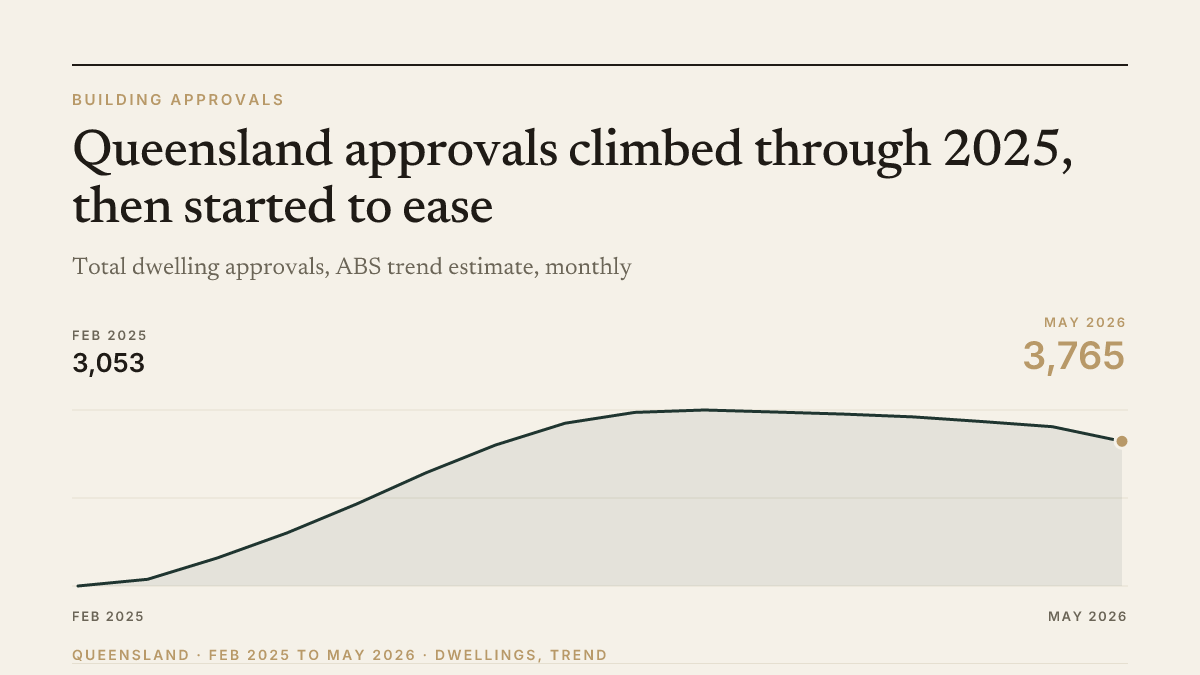
The most recent approvals print is still May, released 1 July, with Queensland down 8.8% seasonally adjusted against a national fall of 1.1% to 17,019 (ABS Building Approvals). June approvals release on 30 July, nine days after this issue lands, so we are not front-running them.
Values tell a similar story. The national Home Value Index fell 0.4% in June, its steepest monthly drop in three and a half years, while Brisbane rose 0.3% to a median of $1,118,306 and remains 17.4% higher over the year (Cotality Home Value Index, June 2026, released 1 July). Brisbane is now one of the last capitals still gaining. That is relative strength by default rather than momentum, and the gap between the two matters when you are pricing a presale.
Note the shape of the week. Two announcements adding tens of thousands of future lots, and a current approvals series still falling. Those are different time horizons and they will not reconcile for years.
We have left the rental vacancy row out this issue. The June SQM figures could not be confirmed against the source at draft time, and we would rather run a short table than an unverified one.
Toowoomba
The state approved a rezoning of a 72-hectare site at Glenvale, about 8km south-west of the Toowoomba CBD, shifting it from Emerging Community to Low-Medium Density Residential on 17 July (The Weekly Source, 17 July 2026). It clears the way for HF Capital Management’s Arena Residences, an over-50s lifestyle resort of more than 320 homes plus a 23-lot subdivision.
The proposal drew 60 submissions in opposition, water supply chief among them. The developer has tied the project’s viability directly to the Westbrook water plant funding announced three days earlier. That is a clean illustration of the sequencing point: the money and the rezoning arrived in the same week, and the second would have been much harder without the first.
Redland
Council resolved on 16 July to advance two major City Plan amendments, residential and non-residential, to the Planning Minister seeking approval for adoption (Redlands Coast Today, 16 July 2026). The package follows 47 properly made submissions received during March consultation, and implements the Redland Housing Strategy 2024 to 2046.
The residential changes are the ones small operators should read. New benchmarks for secondary dwellings occupied by unrelated households, assessment standards enabling small-scale rooming accommodation, consistent minimum frontage widths, tighter assessment of home-based businesses, and modified provisions for low-density residential zones covering canal and lakeside estates. On the non-residential side, craft breweries move from impact to code assessable in certain zones, recreational vehicle sites become possible in rural and environmental zones, and lot reconfiguration in recreation and open space zones gets a higher assessment level.
Separately, council finalised the Local Government Infrastructure Designation for the Birkdale Community Precinct on the same day (Redlands Coast Today, 16 July 2026). The CEO now formally makes the designation, after which notice publishes in the Government Gazette. That is the statutory framework for the Redland Whitewater Centre, a confirmed Brisbane 2032 venue.
Sequencing is the real constraint, not designation.
Halls Creek adds up to 12,000 homes on paper, and the Development Scheme has not been written. Sunshine Coast Council preferred a different site and is asking for input on infrastructure staging. Declarations are cheap relative to trunk infrastructure, and the Toowoomba example three days earlier shows what changes when the money actually arrives.
Labour is the cost story now, not materials.
Turner & Townsend’s 2026 global market report puts construction cost inflation at 4.2% in 2025 rising to 4.5% in 2026, then broadly flat in 2027, with more than 70% of markets reporting skills gaps and little surplus capacity (Turner & Townsend, 8 July 2026). Australia and New Zealand are named as the most acute labour markets globally. Materials volatility has settled. Trade availability has not, and for SEQ that pressure compounds against the 2032 build-up.
A tender-eligibility test is three days away.
Counsel Assisting to the CFMEU Commission of Inquiry published a further submission on 4 July proposing a Queensland Building and Construction Code plus an independent regulator, with draft implementation guidelines attached. Responses close 4pm Friday 24 July (The Good Builder, 8 July 2026). This is a conduct code attached to government money, not the National Construction Code and not a safety standard. It would set what a business must meet to tender for state-funded work, with sanctions up to exclusion for a year, and head contractors would carry responsibility for subcontractor eligibility.
Redland is quietly legislating for the small operator.
Secondary dwellings for unrelated households, small-scale rooming accommodation, consistent frontage minimums. None of that makes a headline, and all of it changes what fits on a suburban lot. Councils across SEQ have been converging on this for a year. The operators who read amendment packages before they commence are the ones who buy the right sites.
The pipeline and the print are telling different stories.
Queensland approvals fell 8.8% in May, and in one week the state announced land supply measured in tens of thousands of lots. Both are true. Approvals reflect what is financeable today at current rates and current trade costs. Declarations reflect what the state wants buildable by the 2040s. Do not let the second one flatter your feasibility on the first.
The bottleneck moved from the software to the org chart
PropTech CoLab released its inaugural Proptech Pulse report on 15 July, launched at the Top of the Props event in Brisbane. It surveyed 146 proptech leaders between March and June, 76% of them at CEO, founder or owner level (Elite Agent, 15 July 2026).
The headline finding runs against the usual AI narrative. The top barrier to adoption is change management and training at 42%, well ahead of integration difficulty and budget, both at 25%. Winning new customers was the top priority for 72% of respondents. Building AI capability was the top priority for 18%. And 65% rated human oversight of AI at four or five out of five.
That last cluster is the interesting one. These are the people selling the software, and they are telling you the constraint is not the model. It is whether anyone in the business will change how they work. Seventy-three per cent said their product has to connect to existing customer systems to deliver anything at all.
For a small SEQ development operation the read is practical. The tooling that will actually help you is the tooling that fits the way you already run a feasibility or a DA, not the tooling that demands you rebuild the process around it. The report’s own conclusion is that the winners are the ones who get what they build adopted and trusted, rather than the ones who build the most. That applies just as squarely to the buyer as the vendor.
ABS Building Approvals, June 2026: releases 30 July 2026. First read on whether Queensland’s 8.8% May fall was a step down or a wobble.
RBA Monetary Policy Board: next decision 11 August 2026.
Halls Creek PDA: Development Scheme preparation underway, public consultation flagged for later in 2026.
Redland City Plan: both major amendments now with the Planning Minister for approval to adopt.
SEQ Regional Plan review: early feedback closed 17 July 2026. No submission summary or government response published as at 20 July.
Residential Activation Fund Round 2: successful projects from the $500 million pool expected to be announced from July 2026.
Subscribe
Not yet on the list?
The SEQ Development Brief lands Tuesday mornings — the big residential development moves across South-East Queensland's twelve councils, plus the occasional update on what we're building. Free.