The SEQ Development Brief
Swish Development
Modular and the money
Factory-built housing finally has money behind it: a big-four bank paying factory invoices, three states writing prefab into their housing programs, and a national certification scheme on the way. This special edition follows the money through a modular deal, from deposit to drawdown to what happens if the factory fails, and sets out how developers and financiers can use the method’s speed without wearing its risks.
The special in six figures. Each is verified to the primary source named in the claims ledger.
Less than 5% of Australian construction is prefabricated, on the figure the Productivity Commission cited in February 2025. Every government in the country has decided that number should rise.
Since early 2025 the money and the rules have followed, and each step removed a specific financing barrier:
- 31 January 2025: Commonwealth Bank becomes the first bank to join prefabAUS and announces it will fund progress payments while a home is still in the factory. Until then its customers funded up to 90% of prefab costs themselves.
- 25 March 2025: the federal government commits $54M: $49.3M to help states scale prefab and modular construction, $4.7M for a voluntary national certification scheme.
- 16 June 2025: WA’s Keystart launches a dedicated modular home loan: low deposit, the factory stage funded, a flat $400 a month during the build.
- 10 July 2025: CBA formalises its policy: up to 80% of the contract price drawable before the home is fixed to land, with an assessed manufacturer.
- 23 November 2025: NSW announces a statewide prefab approval pathway, with prescribed progress payments and statutory warranties to come in home building contracts.
- 28 May 2026: the Housing Minister commits roughly $40M to a national open-source kit of standardised parts (bathroom pods, wall panels, facades).
The Australian Building Codes Board is building the national manufacturer certification scheme now; prefabAUS reports Queensland will participate, with delivery expected in 2028.
None of this guarantees modular wins. It does mean the finance question has moved from “no” to “on what terms”, and the terms are worth understanding before your competitors do.
The case for building in a factory is time.
McKinsey’s 2019 study, still the most-cited evidence in the field, found modular projects completed 20 to 50% faster than conventional builds; its August 2025 follow-up stands by “up to 50 percent” while conceding the sector has seen an above-average number of failures. The Australian versions are more concrete: prefabAUS puts a factory build at 10 to 12 weeks against 18-plus months conventional, and the Queensland government says on-site time can be three months against a year.
Speed converts to money in four places:
- Holding costs stop sooner: interest on the land, rates, insurance and site prelims all run on the clock, not the contract.
- Finance costs shrink: McKinsey’s worked example has financing costs falling by about 5% of total project cost when a two-year build compresses to one year at a 10% cost of capital.
- Presale risk shortens: the gap between exchanging presales and settling stock is where market cycles hurt developers. A faster build closes it.
- Revenue lands earlier: which lifts IRR even when margin is unchanged.
The arithmetic is easy to run on your own numbers. Carry $1.5M of debt at 9% for six months less and you keep roughly $67,000, before prelims, rates and insurance. That is our arithmetic, not a study result, and it is the right shape of calculation for any modular feasibility.
Now the counterweights:
- The Productivity Commission notes that without manufacturing scale, prefab “can be similar, or more expensive than onsite construction”.
- McKinsey found cost savings are the exception, not the norm: logistics can add up to 10% of total cost where transport rules bite, and the factory itself absorbs 5 to 15% of project cost.
- Design freezes early. A production line cannot tolerate the mid-build variations a site builder shrugs off.
- Cranage and transport need engineering on any tight infill site.
Modular pays you in time and charges you in flexibility. Projects that cannot use the time (no holding debt, no presale pressure, no season risk) have little reason to pay the premium.
Here is the tension the whole issue hangs on. A conventional Queensland build is paid in arrears, against work fixed to your land:
| Traditional stage (QBCC schedule) | Payment | Cumulative |
| Deposit | 5% | 5% |
| Base | 15% | 20% |
| Frame | 20% | 40% |
| Enclosed | 25% | 65% |
| Fixing | 20% | 85% |
| Practical completion | 15% | 100% |
A modular contract inverts that. Anchor Homes, a Victorian manufacturer on CBA’s assessed list, publishes its schedule; it sits at the heavier end of an industry that front-loads 75 to 90% of the price before delivery:
| Modular stage (Anchor Homes) | Payment | Cumulative |
| Deposit | 5% | 5% |
| Frame | 20% | 25% |
| Lock-up | 25% | 50% |
| Fixing | 40% | 90% |
| Handover | 10% | 100% |
The frame, lock-up and fixing stages happen in a factory, over eight to ten weeks. Swanbuild’s published terms run the same direction, wanting roughly two-thirds to three-quarters before the home leaves the factory. By the time a modular home reaches your land you have paid for most of it; a conventional builder would have collected about a quarter by the same point on the calendar.
Queensland law adds a twist most people miss:
- Schedule 1B of the QBCC Act caps deposits on domestic building contracts at 5% ($20,000 and over), but lifts the cap to 20% where off-site work is more than half the contract price. Prefab contracts can lawfully take four times the normal deposit.
- Section 34 then only permits claims “directly related to the progress of carrying out the subject work at the building site”. On a domestic contract the manufacturer legally cannot invoice its factory milestones.
- So someone has to carry the work-in-progress: the manufacturer, the customer through that enlarged deposit, or a financier. Westbuilt, a Queensland modular builder, prices the gap on its website: a 1.5% surcharge if your bank will not pay before practical completion, to cover Westbuilt carrying the home in the factory.
Commercial developers contract outside Schedule 1B and negotiate the curve freely, which is where the structures below come in.
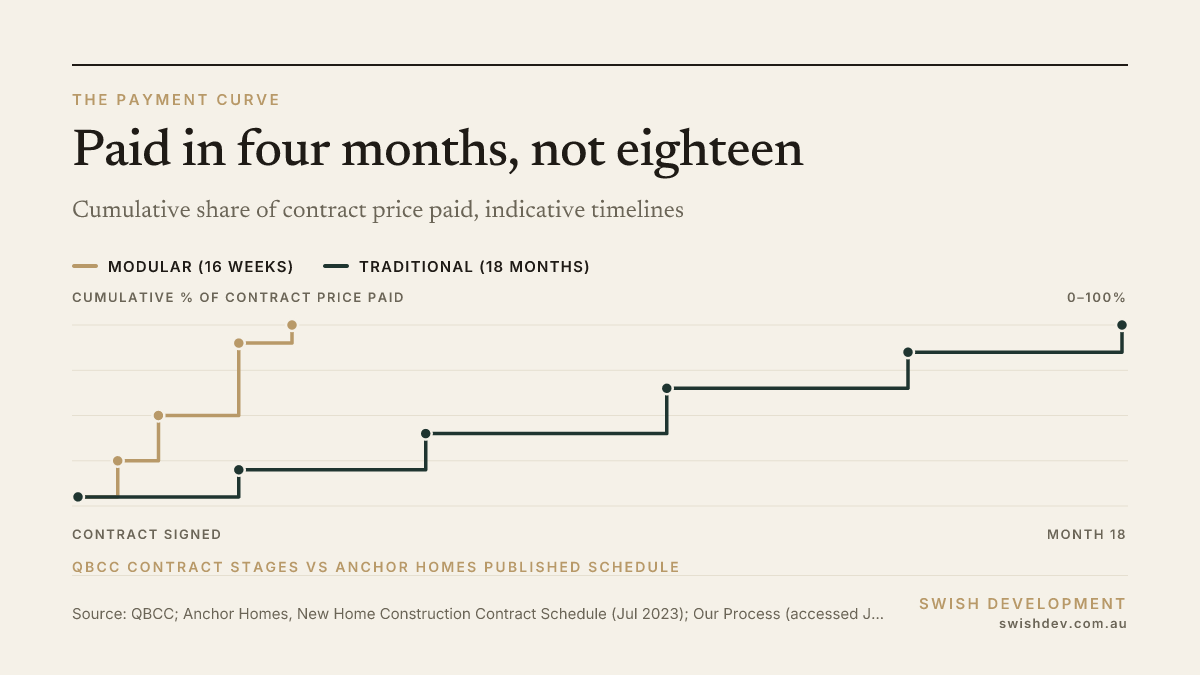
The whole finance problem in one picture: traditional stage claims crawl to 100% over a year or more against work on your land; a modular schedule (shown: Anchor Homes’ published terms, timelines indicative) reaches 90% around installation, inside four months. The money moves earlier, but the exposure window is a third the length. Whether that trade works depends on what the money is exposed to while the home sits in a factory.
A construction loan is secured by a mortgage over land and everything fixed to it. A module on a factory floor 200km away is not fixed to anything. It is personal property, not real property, and the lender’s mortgage gives it no claim over it.
CBA says this in writing, in its own prefab factsheet: “the land will be used as the sole security up until the prefab home is transported to site”, and if the builder fails before fixing, “this may result in negative equity and you will still be required to repay the construction home loan”. That is a bank that lends on modular telling you exactly what it is exposed to. Banks that have not made that choice simply decline.
The law is settled and unforgiving:
- Under the Personal Property Securities Act, goods only reversibly attached to land remain personal property, and an unregistered security interest vests in the company that goes broke.
- In the leading case, a lessor lost gas turbines to the insolvent Forge Group in 2017 because it had not registered its interest on the PPSR. Substitute modules for turbines and you have the modular deposit problem in one judgment.
- Valuation practice compounds it: Australian construction valuations run “as if complete” with site progress inspections, and the API’s standing instructions treat dwellings not permanently affixed as a separate category. The UK’s RICS guidance says the quiet part aloud: without an accepted accreditation scheme, the absence “may limit mortgageability and consequently seriously affect the assessment of value”.
An unfixed module sits outside the standard mortgage machinery on both sides of the world: the security does not attach and the valuation does not count it.
The deadlock is breaking from three directions at once.
The bank route
CBA’s policy, effective 10 July 2025, is the template to study even if you bank elsewhere:
| Term | Assessed manufacturer | Other manufacturer |
| Pre-fixing drawdowns | Up to 80% of contract price | Up to 60% |
| Land equity ceiling | 150% of land value less land debt | 120% |
| Contract | Fixed-price, up to $1.5M | Fixed-price, up to $1.5M |
| Completion test | Fixed to land, connected to services | Same |
Two design choices matter:
- The higher tier follows the manufacturer, not the borrower. It applies only to the 12 manufacturers CBA has financially assessed and factory-inspected: Anchor Homes, Grove Group, JMB Modular, Modscape, Modular WA, PIQUE/Fox Modular, Prebuilt, Saltair Modular, Swanbuild, Todd Devine Homes, TR Homes and Wright Choice Homes (as at July 2026).
- Every pre-fixing dollar is capped against land equity. The more unencumbered land value in the deal, the more of the factory stage the bank will carry. Land-rich, low-geared projects fit; thin ones do not.
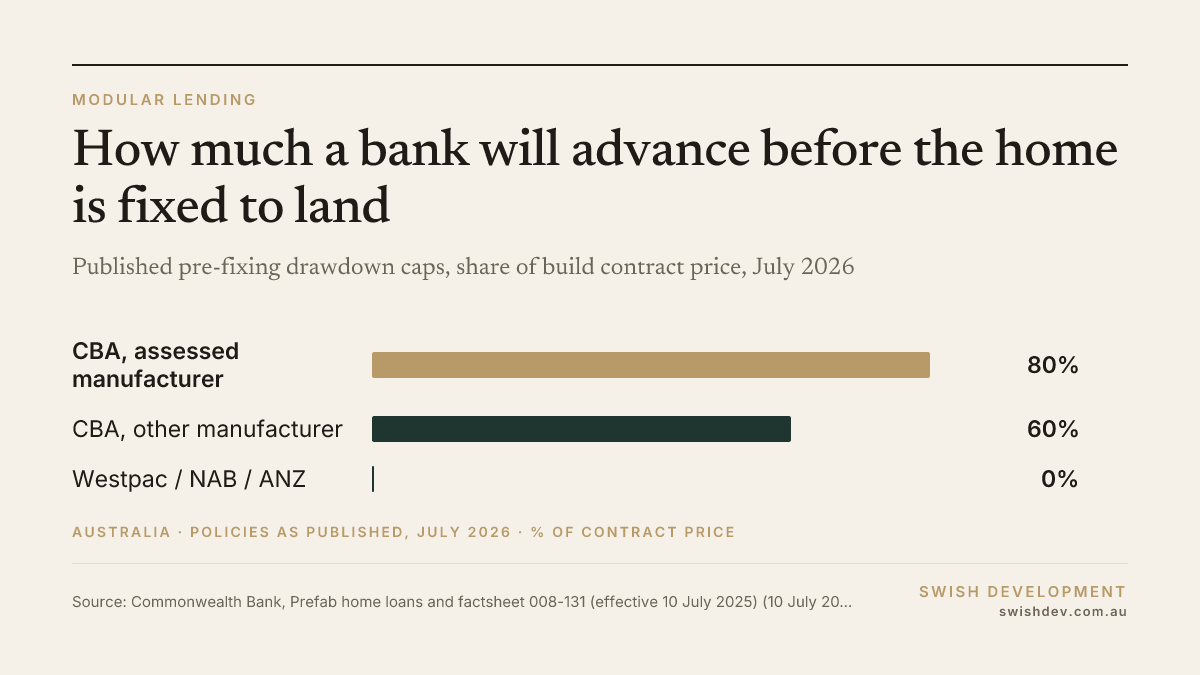
As of July 2026 no other major bank group has published an equivalent. Westpac told reporters in September 2025 it had no planned changes; NAB was “considering”; ANZ declined to comment. Bankwest (CBA-owned) has added a modular progress payment in WA, and Keystart runs the most generous scheme in the country: around 2% deposit, eight approved builders, a flat $400 a month during the build. The gap between CBA’s terms and everyone else’s silence will not last; be positioned for the second mover.
The contract route
For developers outside the consumer framework, the protective instruments are old, cheap and proven. The UK collapses supplied the evidence of which ones work:
| Instrument | What it does | Evidence it matters |
| Escrowed advance payments | Deposits sit in a ring-fenced account, released against milestones | ilke Homes customers recovered 98% through escrow; unsecured creditors got nothing |
| Advance payment and off-site materials bonds | A surety repays if the manufacturer fails before delivery | Aviva bonds paid out on Caledonian Modular contracts |
| Vesting deed | Title to identified, insured, segregated modules passes as you pay | Standard UK practice; what lenders certify against |
| PPSR registration | Perfects your interest so modules do not vest in the insolvent estate | The Forge Group lesson |
| Step-in rights | You can take over the manufacturing contract on insolvency | UK practice guidance since 2020 |
| Assessed manufacturer | Someone with audit access has checked the factory’s finances | CBA’s roster doubles as free due diligence |
None of these is exotic. A vesting deed plus a PPSR registration costs a fraction of one per cent of contract value. The ilke evidence below prices the difference at roughly the whole deposit.
The manufacturer route
We looked hard for manufacturers financing projects themselves. It exists at the edges, not the middle:
- Westbuilt (Qld): the clearest Australian offer, in-house debtor finance at a 1.5% surcharge. Consumer-scale.
- Swanbuild: advertises a bridging package for construction loans.
- Ausco and Fleetwood: the commercial end flips to manufacturer-as-owner. Ausco hires out buildings; Fleetwood designs, builds, owns and operates whole accommodation villages. The customer never finances construction at all.
- No Australian manufacturer offers developer-scale deferred-to-settlement terms or equity participation, on the evidence available.
- Japan integrates finance: Sekisui House’s US arm wrote US$2.65B of mortgages in 2025 for its own buyers; Daiwa House offers in-house loans and manages 720,000+ rental units. Neither extends it to Australian projects.
- Chinese exporters do the opposite: CIMC markets its buildings as “fundable, mortgageable and insurable” and asks on its enquiry form whether you have secured funding.
- The cautionary tale: the UK’s Legal & General experiment, where the financier owned the factory, ended with the parent absorbing £289M of accumulated losses. The factory taking the paper concentrates the risk; it does not solve it.
Between March 2022 and November 2024 the UK lost essentially its entire flagship modular sector: Caledonian Modular, House by Urban Splash, ilke Homes, L&G Modular, Modulous and TopHat.
This matters to an Australian reader for one reason: the administrators’ reports are a complete, public record of who lost money, who did not, and why. The UK paid the tuition. The lessons are free.
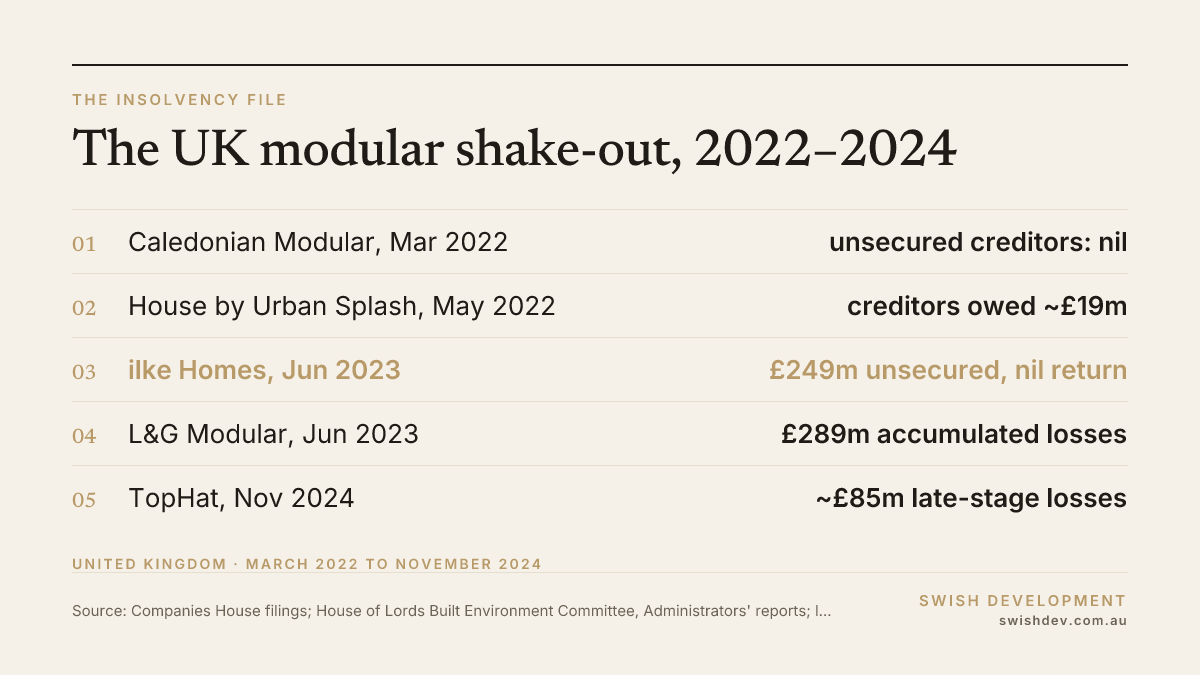
The mechanism was the same each time:
- Fixed costs met a lumpy order book. A factory carries high fixed costs and a permanent workforce, which the House of Lords committee called “entirely different from the model of traditional builders”.
- Factories were built to venture scale ahead of demand. ilke’s plant was sized for thousands of homes a year it never sold; TopHat wrote off £18.3M aborting a plant designed for 4,000.
- The death spiral closed, in the UK government’s own words: customers were “reluctant to place large orders with manufacturers who are not yet profitable, in-case they cease operating before or during the manufacturing process”. Fear of collapse caused the order famine that caused the collapse. L&G’s official explanation: it could not “secure the necessary scale of pipeline to make the current model work”.
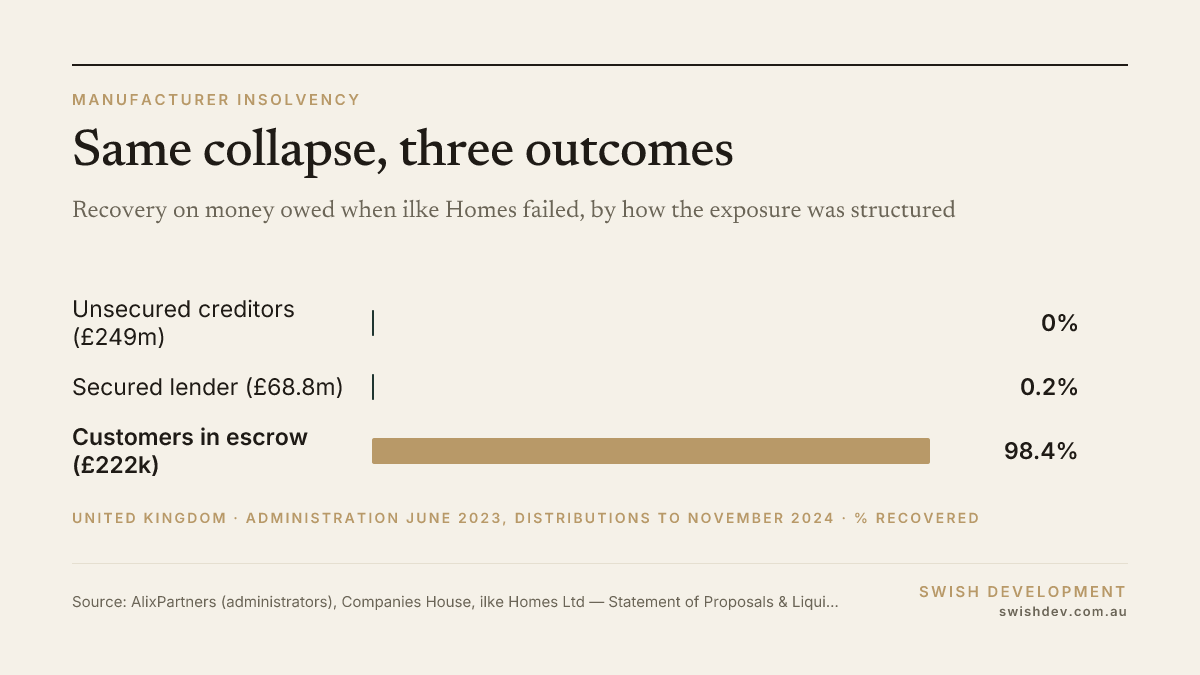
Inside the ilke administration, outcomes split three ways. This is the most useful finance lesson in the issue:
- Unsecured creditors: owed £249M, received nothing.
- Homes England, the UK government’s housing agency, secured lender, owed £68.8M: recovered £128,423 from the main company, about 0.2% (modest further recoveries came from other group entities).
- Customers with escrowed deposits: recovered 98%. £218,262 of £221,843 held in ring-fenced Barclays accounts, adjudicated and repaid by the bank.
Same collapse, same week, three outcomes, decided entirely by deal structure.
The modules themselves taught a second lesson. ilke held around 360 finished and part-finished modules at collapse. They proved nearly worthless: bespoke to customers’ sites, tangled in supplier title claims, their certification manuals locked in a software system the administrators could not access because the bills were unpaid. The entire stock, plus the company’s IP, sold for £125,000. Whoever holds title to a part-built module in an insolvency holds much less than they think.
Two Australian footnotes:
- Strongbuild (NSW) entered administration in November 2018 after a single $45M contract was cancelled and a lending facility fell away with it, on contemporary reporting. One customer, one order book, one point of failure.
- The Queensland gap: the QBCC Act allows a 20% prefab deposit, yet QBCC’s claims manual excludes “off-site prefabrication of the whole of a building” from the Home Warranty Scheme, and any excess over the lawful deposit is unrecoverable under the scheme. As at July 2026: four times the standard deposit, zero warranty cover until the work is on site. If you sell modular to Queensland consumers, an escrow or bond over the deposit belongs in your contract.
The comparison that matters is not Australia against the UK’s failure; it is Australia against the countries where factory housing quietly works.
| Country | What makes it financeable | Where it stands |
| Japan | Manufacturers integrate finance, land and after-care; decades of steady demand | Sekisui House: 2.7M+ homes built cumulatively |
| Sweden | State-anchored demand since the Million Homes Programme built lasting capacity | Industry reports ~80% of houses use factory-built elements |
| UK | Lender assurance existed (BOPAS, 2013) but demand was a soft ambition | Flagship factories collapsed 2022–2024 |
| NZ | Westpac NZ built the first dedicated prefab mortgage (2019) | Product survives; scale modest |
| Australia | Bank accreditation, government factories and orders, certification by 2028 | Under construction now |
The pattern is plain: modular scales where demand is steady and the financier can trust the manufacturer, and fails where factories are built on hope.
Australia is running a different order of operations from the UK, and it is the right one:
- The orders are real. QBuild’s factories at Eagle Farm, Zillmere and Cairns are government-owned and feed the state’s own social housing program (up to 600 modular homes committed). NSW is piloting modular social housing directly. WA is co-funding two factories with $48M. Governments here are customers and manufacturers, not just shareholders.
- The manufacturers are boringly structured. CBA’s assessed list is dominated by decades-old private businesses that grew with their order books. Modscape’s plant makes about 2,000 modules a year; Oly Homes steps from 200 to about 550 homes a year, bank-funded, by late 2026. Nobody is burning venture capital toward a five-thousand-home target.
- The screening attacks the death spiral directly. BOPAS certified the home would last 60 years, never that the factory would last the build. CBA’s accreditation assesses the manufacturer’s finances and inspects the factory, then prices lending off it. That repairs the exact trust link that snapped in the UK.
- The rules are arriving before the boom. NSW’s prescribed progress payments, ABCB certification and the kit-of-parts program all target the plumbing. Standardisation also chips at the bespoke-module problem that made ilke’s stock worthless.
What to expect from here, on the pattern: the ABCB scheme lands around 2028 and gives every lender a national accreditation to hang policy on; a second bank moves before then; valuers get standing instructions for certified prefab; progress-payment reform spreads from NSW. Each step is the Australian version of something that already worked somewhere else.
The remaining risk is the one no scheme removes: individual manufacturers will still fail. That is why the contract toolkit is not optional.
For developers
- Screen projects for time value: modular pays where holding debt, presale windows or weather risk make weeks expensive. Run the interest arithmetic on your own feaso before pricing the premium.
- Use the accreditation lists as free due diligence: CBA’s 12 assessed manufacturers and Keystart’s approved builders have had their finances checked by institutions with audit access.
- Structure the factory stage like the unsecured loan it is: escrow or bond every dollar ahead of delivery, take a vesting deed over identified modules, register on the PPSR, ask for step-in rights. The ilke estate priced the difference at 98 cents in the pound.
- Bring land equity: pre-fixing drawdowns are capped against unencumbered land value. Clean land supports the largest factory-stage funding.
- Design to the standard, freeze early: variations are cheap on site and ruinous on a production line, and a standard module holds value in a way ilke’s bespoke stock did not.
- Selling to Queensland consumers: mind the 20% deposit power and the warranty gap; an escrowed deposit is both a protection and a selling point.
For financiers
- The security problem is solved in pieces, not in principle: land-equity caps, assessed manufacturers, escrow and vesting each carve a piece off the exposure. CBA has published the template; the second mover gets it free.
- Underwrite the manufacturer, not just the borrower: order-book concentration and fixed-cost coverage are the variables that kill. One cancelled contract ended Strongbuild.
- Escrow is cheap protection with proven recovery: the one mechanism that returned customer money at scale in an MMC insolvency was a ring-fenced bank account.
- Watch the 2028 certification date: a national accreditation scheme gives every lender the infrastructure CBA built privately. Product built now positions for it.
The through-line of this issue is unusually clean. Modular’s finance problem is real, precisely locatable, and being dismantled piece by piece, with the expensive experiments already run offshore and documented in administrators’ reports. The developers who learn the structures early get a faster build, a shorter exposure window and a funding market that is finally turning up. We would rather be early to that than late.
Modular trades duration risk for counterparty risk.
A conventional build exposes you to eighteen months of market, weather and builder risk while your cash goes out slowly. Modular compresses that to about four months but asks for most of the money while the home is still someone else’s chattel in someone else’s shed. Price both sides in the feaso.
Paperwork decides who survives a collapse.
The ilke estate returned 98 cents in the pound to escrowed customers and zero to everyone else. Escrow, vesting deeds, PPSR registration and bonds are cheap relative to a 20% deposit; treat them as the cost of admission.
Queensland’s deposit rules cut both ways.
The 20% prefab deposit allowance makes modular contracts workable for manufacturers, but the warranty scheme excludes off-site prefabrication, so the bigger deposit rides uncovered until the work is on site. Lead with an escrowed deposit as a point of difference.
Land equity is the new gearing lever.
CBA caps pre-fixing drawdowns at 150% of land value less land debt. That quietly rewards land-rich, low-geared projects with the most factory-stage funding, the reverse of how developers usually think about gearing a site.
Factories die of order famine, not bad product.
Every UK collapse traces to fixed costs meeting a lumpy order book. The safest Australian counterparties are the ones with government or bank-assessed order books, which is exactly what QBuild’s pipeline and CBA’s roster now provide.
Australia is sequencing this correctly.
The UK built factories first and the trust infrastructure never caught up. Australia is building the trust infrastructure first: bank accreditation now, prescribed progress payments in NSW, national certification by 2028, with governments as anchor customers rather than shareholders. That is why the positive read is the evidence-based one.
Westpac, NAB and ANZ: no equivalent published policy; Westpac said in September 2025 it had no planned changes. The first mover among them changes the market.
Oly Homes: CBA-funded Sunshine Coast factory stepping from 200 to about 550 homes a year, due to complete in late 2026.
QBuild: state-owned modular factories at Eagle Farm, Zillmere and Cairns, up to 600 modular homes committed.
Modscape: the country’s largest offsite plant at Essendon Fields, about 2,000 modules a year capacity.
2027-28: remaining federal prefab allocations flow to the states (2026-27 Budget Paper No. 3 lists state splits as not yet determined).
2028: ABCB national manufacturer certification expected (per prefabAUS); a second major bank moving before that date is the signal to watch.
Subscribe
Not yet on the list?
The SEQ Development Brief lands Tuesday mornings — the big residential development moves across South-East Queensland's twelve councils, plus the occasional update on what we're building. Free.