The SEQ Development Brief
Swish Development
A statewide housing code, and six Modern Homes rules eased
The Queensland Government released the new Queensland Housing Code on 3 August, the first rewrite of the state’s residential design and siting rules in more than 15 years. The Code replaces the design and siting provisions of the Queensland Development Code and sets statewide standards for building height, setbacks, visual privacy, car parking, site cover and private open space. It covers detached houses and secondary dwellings.
Two dates matter here, and they are not the same date.
The Modern Homes Standards amendments commence on 14 August 2026. Six changes land then. Homes under 50 square metres drop from a seven-star to a five-star building shell rating. Raised-floor construction drops from seven stars to six. Elevated homes get a ramp-ready option in place of an installed ramp. Accessible bathroom design gets flexibility in place of prescribed layouts. Weatherproofing and step-free entry pick up new compliance solutions. And the narrow-lot exemption, due to expire next month, now runs to 30 September 2029 (ArchitectureAu, 4 August).
The Housing Code itself is the slower instrument. Councils can adopt it during a three-year transition period starting 1 September 2026, supported by a streamlined scheme amendment pathway. Adoption is not compulsory. Until a council amends its planning scheme, that scheme’s existing provisions still apply.
For anyone running numbers on a secondary dwelling or a small infill product, that split is the whole story. The energy rating change is a build-cost input and it applies from Friday, whichever council you are in. The siting rules, the ones that drive yield through setbacks and site cover, only move when your council moves.
Minister for Housing and Public Works Sam O’Connor framed the package around removing red tape, against a state target of one million homes by 2044. Housing Industry Association Queensland executive director Michael Roberts said the Code would deliver “greater consistency, certainty and efficiency” (HIA, 3 August). Consistency is the part worth watching, because the case the state made for the Code was that roughly three-quarters of councils were running different housing requirements. Queensland adopts NCC 2025 on 1 May 2027, so this is a staging post rather than a settled position.
The approvals boom went everywhere except the Sunshine Coast
On 6 August the ABS published the small-area data cubes behind its June building approvals release, which give financial-year approval counts by local government area (ABS, Building Approvals, Australia, June 2026).
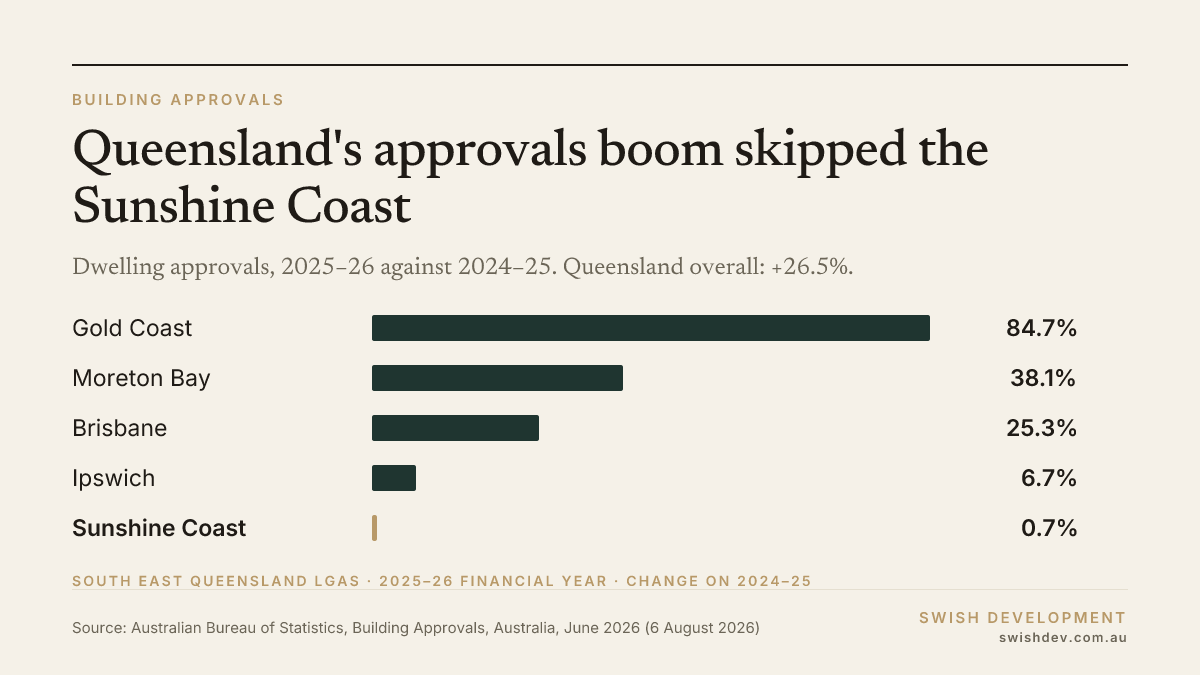
Queensland approved 48,584 dwellings in 2025-26, up from 38,420 the year before, a lift of 26.5%. The Sunshine Coast approved 3,244, against 3,221. Twenty-three dwellings.
The rest of SEQ ran hard. Gold Coast approvals rose 84.7% to 7,622. Moreton Bay lifted 38.1% to 6,636, Brisbane 25.3% to 9,237, Logan 22.1% to 5,035, and Redland 21.9% to 1,677. Ipswich managed 6.7%. Noosa, counted separately from the Sunshine Coast, fell 14.4% to 244. The Gold Coast’s increase on its own, 3,495 dwellings, is larger than the Sunshine Coast’s entire year.
Inside the Coast number, detached houses went backwards, 1,844 down to 1,817. Units and townhouses covered the gap, 1,355 up to 1,413, lifting the medium-density share of Coast approvals from 42.1% to 43.6%.
These are original-terms figures. The ABS publishes small-area approvals unadjusted, so no seasonally adjusted equivalent exists at LGA level, and 2025-26 small-area numbers are preliminary and revise in later releases.
Flat approvals against a growing population is a supply signal, not a demand one. The specific read for operators on the Coast sits in the composition: the only part of the Coast pipeline that grew was attached product, and it grew while detached fell. That is also the segment where the Housing Code’s secondary-dwelling standards and the sub-50 square metre rating change both land.
The RBA decides at 2:30pm on Tuesday 11 August, alongside the quarterly Statement on Monetary Policy. This issue goes out that morning, so the table below carries the cash rate as it stands rather than as it may read by close of business.
Inflation gave the board cover to sit still. CPI rose 3.8% over the twelve months to June, down from 4.0% in the year to May, while trimmed mean inflation held at 3.6% (ABS, released 29 July). Brisbane ran at 4.0%, above the national figure.
Values are the softer number. National dwelling values fell 0.7% in July, the largest single-month decline since December 2022, and Brisbane fell 0.6% (Cotality, 1 August). The split by price tier is sharper than the headline: upper-quartile values fell 3.2% nationally across the three months to July while the lower quartile gained 0.3%.
Auction volumes thinned. Across the combined capitals 1,257 homes went to auction in the week ending 2 August, down 11.2% on the week before, clearing 48.9%. Brisbane cleared 37.5% on 136 auctions, up from 29.5% (Cotality, reported 7 August).
The June-quarter Lending Indicators and the July vacancy print both land after this issue. Both are in On our radar.
The end-value assumption is the one that moved
Nothing in the funding table changed this week. What changed is the number you feed into it.
Development finance is sized off end value, and the end value that matters to a lender is the one at the top of a project’s price range. Cotality’s July index has upper-quartile values down 3.2% nationally over three months while the lower quartile gained 0.3% (Cotality, 1 August). A lender re-testing a feasibility today is looking at a market where the premium end is falling and the affordable end is not. Presale valuations on larger, higher-spec stock are where that shows up first.
The funding table itself has been widening for years. Bank share of total commercial real estate lending fell from 87% to 75% as banks halved CRE exposure relative to assets, and credit funds now typically target returns of 3% to 6.5% above the cash rate (Knight Frank, October 2025). Broker commentary through 2026 has banks generally holding around 50% presale cover by debt while easing on projects with broad appeal, and non-bank senior lenders accepting materially less, at pricing well above bank senior (Mortgage Professional Australia, 12 May 2026). Neither of those settings is new. What is new is that the valuation input feeding both has started to move in one direction at the top of the market and another at the bottom.
The counterparty backdrop improved slightly. ASIC’s insolvency statistics to 28 June 2026 show 3,435 construction companies entering external administration in 2025-26, down from 3,596, the first annual fall since the post-COVID wave began. Queensland was flat: 563 against 565 (ASIC, published 13 July). Flat is not falling, and the composition shifted toward liquidation rather than restructuring, but the direction stopped getting worse.
Read together with this week’s approvals cubes, the SEQ implication is narrow and specific. Coast operators are bringing forward attached product into a market where the affordable tier is holding value and the premium tier is not, and where the lenders most willing to fund without deep presales are also the most expensive. Which of those constraints binds first is a project-by-project question, and it is worth asking before the feasibility goes to a desk rather than after. This section reports conditions and does not recommend any product or lender.
Brisbane
The draft Legacy Plan for the Victoria Park Precinct went to public consultation at 9am on 3 August, with submissions open to 27 September 2026. Prepared by Arup, the plan sets out how the site works after the 2032 Games rather than during them. About two thirds of Victoria Park stays free public green space, wrapped around the 63,000-seat Brisbane Stadium, the National Aquatic Centre and the Brisbane Showgrounds.
Proposed moves include a public amphitheatre, a community sports hub with an athletics track, an expanded York’s Hollow wetland and urban forest, a ridgeline park loop, and two pedestrian bridges over the Inner City Bypass and the rail corridor. The final plan is due in 2027.
The precinct itself is state-delivered and not a small-operator opportunity. The consultation record is the useful part, because the access and connection decisions made here set the walking catchment for the inner-north suburbs on either side of the bypass.
Sunshine Coast
Habitat Development Group’s Rivienne is testing the gap between the current Sunshine Coast scheme and the draft one. The proposal for 132 and 134-136 Aerodrome Road, Maroochydore, is 18 storeys and 62.97 metres for 180 apartments, against a current height limit of 40 metres. The draft scheme would allow 60 metres, which the proposal still exceeds once rooftop elements are counted. Council has asked for visual and shadow studies and further justification for the exceedance. Public notification ran from 20 July and closed on 10 August. Managing director Cleighton Clark said the development was consistent with the council’s draft scheme and put construction-phase employment at 1,100 workers (Sunshine Coast News, 7 August).
Further south, Stockland’s proposed changes to the western detention basin serving Aura at Bells Creek hit a council objection. The application is a minor change request to conditions on a 2016 state approval, assessed by the State Assessment and Referral Agency. On 20 July the council objected to the revised basin plans and to the haulage route changes, while agreeing to one condition update. Its stated reasons were that the haulage changes would allow alternative routes to be approved later without certainty about final arrangements or the council’s role, and that the basin’s engineering suitability for long-term council maintenance was not established (Sunshine Coast News, 4 August). The basin serves Aura precincts 12 and 13.
Two clocks, one reform.
The Modern Homes changes commence on 14 August statewide, while the Housing Code waits on each council from 1 September. A feasibility that assumes both arrive together will be wrong for as long as your council sits on the second one. The rating change is bankable now; the setback and site-cover changes are not.
Small dwellings got cheaper to build, on paper.
Dropping homes under 50 square metres from seven stars to five, and raised-floor construction from seven to six, cuts the shell specification on exactly the product a secondary dwelling is. That lands the same week ABS data shows attached product was the only growing part of Sunshine Coast approvals, 1,355 up to 1,413.
The Coast’s constraint is approvals, not appetite.
Queensland approved 26.5% more dwellings in 2025-26 and the Sunshine Coast approved 0.7% more. Gold Coast, Moreton Bay, Brisbane, Logan and Redland all cleared 20%. A region that flat against a state that steep is a pipeline problem, and it is the reason Coast site competition has not eased.
The price-tier split changes which project is safe.
Upper-quartile values fell 3.2% over three months to July while the lower quartile rose 0.3% (Cotality, 1 August). Feasibilities carrying premium end values through to settlement are carrying the part of the market that is actually falling.
Height is being tested ahead of the scheme.
Rivienne is a 62.97-metre proposal on a 40-metre site, justified against a draft scheme that allows 60. Whatever the council decides, the assessment record it creates is the reference point for the next Maroochydore application, and the draft scheme becomes the de facto benchmark before it is adopted.
14 August 2026: Modern Homes Standards amendments commence, including the five-star rating for homes under 50 square metres.
14 August 2026: ABS Lending Indicators, June quarter 2026.
1 September 2026: Councils can begin adopting the Queensland Housing Code, with a three-year transition window.
27 September 2026: Submissions close on the draft Victoria Park Precinct Legacy Plan.
1 May 2027: Queensland adopts NCC 2025.
30 September 2029: Narrow-lot exemption expires under the extended Modern Homes Standards.
Subscribe
Not yet on the list?
The SEQ Development Brief lands Tuesday mornings — the big residential development moves across South-East Queensland's twelve councils, plus the occasional update on what we're building. Free.