The SEQ Development Brief
Swish Development
RBA holds at 4.35%, and keeps the tightening bias
The Monetary Policy Board left the cash rate target unchanged at 4.35% on 11 August. The decision was unanimous. It is the third consecutive hold, following three rises in February, March and May that took the rate up from 3.6%.
The wording carries more information than the decision did. The Board said it “will continue to do what it considers necessary to bring inflation sustainably back to target, including increasing the cash rate target further if upside risks materialise.” The Statement on Monetary Policy published alongside it forecasts underlying inflation falling to 3.3% by the end of 2026, revised down from the 3.5% the Bank published in May, and judges the risks around that forecast to sit on the upside (CommBank, 11 August).
That combination describes a central bank which has stopped tightening without concluding it is finished. Anyone carrying a rate cut in a feasibility for the back half of this year is now doing so against an explicit refusal to signal one. On a 12 to 18 month build programme, holding costs are better modelled at today’s pricing.
The practical read for small operators sits in the gap between the hold and the language. A hold stabilises serviceability assessments, which have been a moving target since February. A retained tightening bias keeps the banks conservative on valuation and presale coverage, because their own credit committees are pricing the same upside risk the Board named. Stable inputs, cautious lenders.
New home lending fell 5.4% in the June quarter, and investors led it down
The ABS released June quarter Lending Indicators on 14 August. The number of new loan commitments for dwellings fell 5.4% to 134,225. The value fell 5.2%, or $5.4 billion.
The composition is where the signal is. Investor commitments fell 8.6%, a drop of 4,966 loans. Owner-occupier commitments fell 3.3%, or 2,745 loans, and now sit 1.6% below a year ago. First home buyers held up best of the three, down 2.9% for the quarter and unchanged over the year.
Investor annual growth slowed from 19.4% to 2.8% in a single quarter. Queensland investor loans fell 10.1%, the third-largest decline of any state.
Loan sizes did not follow volumes down. The average Queensland owner-occupier commitment rose to $751,000 in June, from $741,000 in March. The average Queensland investor commitment rose to $713,000, from $711,000. Fewer borrowers, each carrying more debt.
For small residential developers the investor line is the one that bites. Investor demand and presale depth on two to six lot product move together, and a 10.1% quarterly fall in Queensland investor commitments thins the pool a project draws on to clear a presale hurdle. First home buyer resilience points the other way, toward product that qualifies for the $30,000 grant and lands under the transfer duty thresholds. On current numbers, a scheme designed around owner-occupier entry buyers has a deeper market behind it than one designed around investor stock.
The June quarter Lending Indicators are the fresh print this week. Everything else in the table is carried at its most recent released value, because the next cluster of releases falls after this issue goes out. The Wage Price Index for the June quarter releases on 19 August, the day after send, so no wages figure is stated here.
Cotality’s July Home Value Index, released 3 August, recorded a national fall of 0.7%, the largest single-month decline since December 2022. Brisbane fell 0.6%. That is the second consecutive month of national decline and the first sustained turn Brisbane has joined.
ABS Building Approvals for June, released 30 July, remain the latest monthly print. National total dwellings approved rose 7.2% to 18,328, with Queensland up 33.4% in seasonally adjusted terms, the strongest state result.
SQM Research put the national residential vacancy rate at 1.3% in July, unchanged from June, with Brisbane steady at 0.9%. Total vacancies rose to 40,771 dwellings from 39,229, so stock is loosening slightly even where the headline rate has not moved.
What CBA’s book says that the quarterly print does not
Commonwealth Bank reported its full year result on 12 August, for the year to 30 June 2026. Cash net profit after tax was $10,982 million, up 7%. Statutory net profit was $10,911 million, up 8%. Net interest margin was 2.05%, down three basis points on the prior year.
The lending numbers are the interesting part for anyone financing a project. Loan impairment expense came in at $788 million, a loan loss rate of eight basis points, up 9% on the prior year and up 47% on the first half. Home loan arrears sat at 0.73% and personal loan arrears at 1.72%, which the bank attributed to cost-of-living pressure. Provision coverage held at 1.53% of credit risk weighted assets, with the bank carrying a $2.7 billion buffer above its central scenario. Common Equity Tier 1 finished at 12.0%.
None of that describes a bank pulling back. Across the year CBA deployed 72 basis points of capital into credit risk weighted assets with what it called strong volume growth “particularly in commercial portfolios and domestic residential mortgages”, and backed businesses with $50 billion in funding. Arrears are drifting up from a low base while the balance sheet keeps growing into the same book.
The outlook line is the one worth sitting with. Matt Comyn wrote that “housing activity has softened from a high base” and that “application volumes appear to have stabilised in recent weeks”. Set that against the June quarter Lending Indicators above and the two readings are not in conflict, they are sequential. The quarter to June captured the fall. The weeks since have captured a floor. A quarterly print is always a description of a period that has already ended, and the largest home lender in the country is saying the period ended.
Where that leaves development finance is roughly where it has been. The major banks continue to sit around 50% presales measured by debt coverage, while alternative lenders will work below that, some without a presale requirement at all, generally lending 70% to 80% of total development costs or gross realisable value at materially higher pricing (Mortgage Professional Australia, 12 May). La Trobe Financial, Chifley Securities, Millbrook Group and Pallas Capital are the names most often quoted in that band.
The point is not that one funding path beats another. It is that a softer investor market changes which hurdle binds first. When presales are harder to assemble, the constraint on a small scheme stops being serviceability and becomes presale coverage, and that is a question about which lender panel a project is being taken to rather than about the project itself. Worth knowing which desks are open before the next feasibility is priced, not a reason to move on any particular one.
Sunshine Coast
Two applications lodged this month test the region’s height rules from opposite ends of the scale.
Walker Corporation has lodged plans with Economic Development Queensland for a 30-storey, 98.77 metre building at Lot 30 Sunshine Coast Parade in the Maroochydore City Centre. The planning report states it would be the tallest building on the Sunshine Coast. The proposal covers 208 apartments from one to four bedrooms on a 2,376 square metre corner site, with ground-level retail, three parking levels and communal amenity including a pool and gym. Council has confirmed its support (Sunshine Coast News, 11 August).
At the other end, Briksea Developments lodged an impact assessable application with Sunshine Coast Council for Buddina Residences, a four-storey building of 13.4 metres holding three apartments across 13 Pacific Boulevard and 2 Harbour Parade, Buddina. The site looks over Buddina Beach on one side and the Mooloolah River and La Balsa Park on the other. The complication is that the two lots carry different controls. The Pacific Boulevard lot is low density residential with an 8.5 metre limit, the Harbour Parade lot is tourist accommodation with a 12 metre limit, and the proposal exceeds both. It also extends apartments onto the low density residential lot, which raises a land use question as well as a height one. The town planning report argues the building “will not result in significant adverse visual impacts” and “presents as a low-rise residential building that is compatible with the established built form character” (Sunshine Coast News, 13 August).
The two sit at very different scales but turn on the same question, which is how much weight a Sunshine Coast assessment gives a stated height limit when the surrounding context has moved. Walker is asking inside a priority development area with council support behind it. Briksea is asking on a split-zoned suburban corner through impact assessment and public notification. The second is the more useful precedent for small operators, because split-zoned sites with a low density lot on one title are common across the Coast’s beachside pockets, and the outcome here will indicate whether that configuration can carry a modest lift.
Investor credit is where the cycle landed.
Queensland investor loan commitments fell 10.1% in the June quarter against a national investor fall of 8.6%, while national investor annual growth collapsed from 19.4% to 2.8%. Owner-occupier and first home buyer volumes fell far less. The tightening has not hit housing credit evenly, it has hit one segment, and that segment is the one small unit and townhouse schemes have leaned on for presales.
Entry-buyer product has the deeper market right now.
First home buyer commitments fell 2.9% for the quarter and finished unchanged on the year, the most resilient of the three borrower categories in the June figures. Against a 10.1% fall in Queensland investor lending, schemes configured for owner-occupier entry buyers are being designed into the stronger half of the market.
Loan sizes rising into falling volumes is a selection effect.
The average Queensland owner-occupier commitment rose to $751,000 from $741,000 across the same quarter that volumes fell 5.4% nationally. Marginal borrowers are leaving the market while better-capitalised ones remain. Price points set off 2025 buyer depth will read the remaining market wrong.
The hold is not the easing cycle.
The Board retained explicit language about raising further if upside risks materialise, and the August Statement on Monetary Policy put the risks around its own inflation forecast on the upside. A feasibility carrying a cut in the second half of 2026 is carrying an assumption the Bank has declined to give.
Queensland did not join the builder recovery.
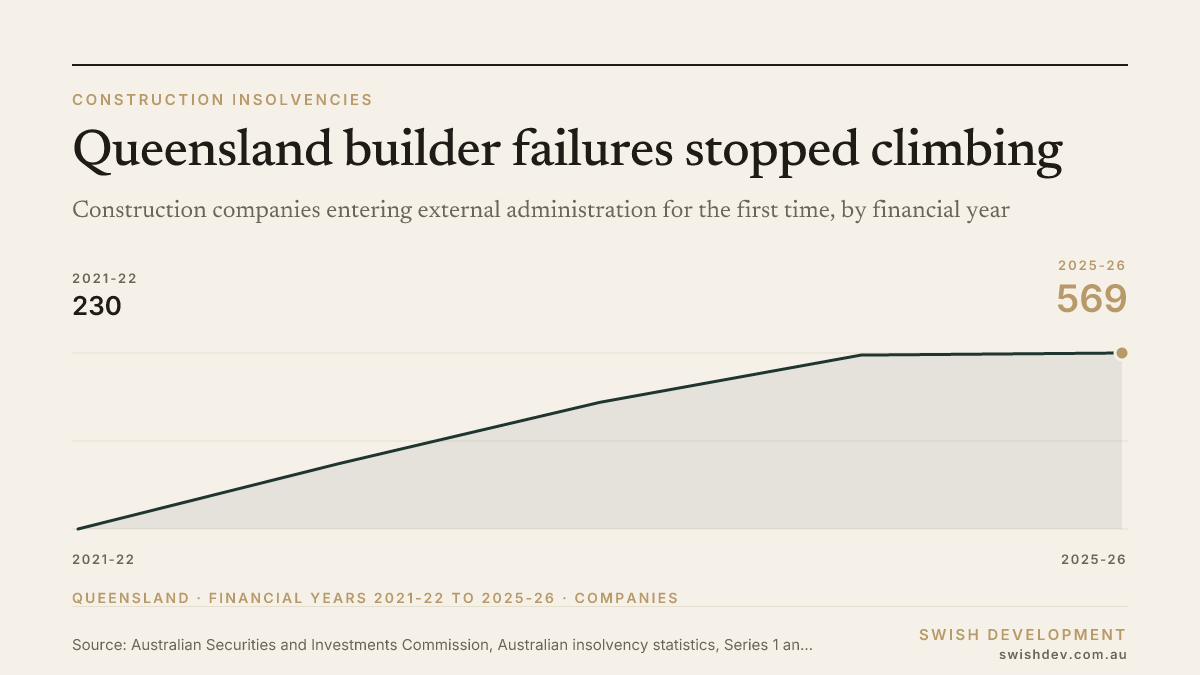
ASIC’s Series 1 insolvency data, updated 11 August, shows construction was the industry where first-time external administrations stopped rising nationally this financial year, the first break in the post-COVID climb. Queensland did not follow it down. Its count sat flat against the 565 recorded in 2024-25 while New South Wales and Victoria both eased. Counterparty diligence on a Queensland head contractor is not getting easier just because the national line turned.
The land contest nobody zoned for
The Housing Industry Association warned on 17 August that data centres are competing directly with housing for scarce, well-serviced land on the Sunshine Coast. Simon Croft, the HIA’s chief executive of policy and industry, framed it precisely: “The key issue is not whether data centres should be built, but ensuring their growth does not come at the expense of housing supply” (Sunshine Coast News, 17 August).
The specifics are local. NEXTDC already operates one facility in the Maroochydore CBD, and a $200 million AI-ready second facility is under construction at 10 South Sea Islander Way, due to open in the first half of 2027. Its planned capacity could draw electricity equivalent to roughly 10,500 homes a year at full load, before cooling. The state has an SEQ Data Centre Strategy and released a South East Queensland Digital Plan in April. Sunshine Coast Council has no plans to introduce specific data centre land-use provisions in its proposed new planning scheme.
This is the part of the AI build-out that reaches residential development, and it does not arrive as a tool. It arrives as a competing bidder for exactly the land small developers want, which is serviced, power-connected, close to a centre, and already zoned for something intensive. A data centre outbids housing on that land comfortably. It pays more per square metre, it does not care about views or amenity, it carries no presale risk, and it is not waiting on a lending cycle that just took investor commitments down 10.1% in a quarter.
The absence of specific provisions is the operative fact. Where a planning scheme has no data centre land use, these proposals are assessed against whatever industrial or business code fits closest, which tends to be permissive on exactly the attributes that make the site valuable for housing. The Sunshine Coast is also the LGA that approved 3,244 dwellings in 2025-26 against 3,221 the year before, effectively flat while Queensland ran up 26.5%, so the region has the least headroom in SEQ to lose serviced land to another use.
For anyone acquiring on the Coast, the read is narrow and practical. Serviced industrial-adjacent land near Maroochydore now has a second class of buyer with a different cost of capital and a different yield test. That changes comparable sales, and it changes them in a direction that will not be obvious from residential comps alone. Watch what the proposed planning scheme does or does not say about the use before the next acquisition, because the scheme is the only place this gets resolved.
20 August 2026: ABS Labour Force, July 2026.
26 August 2026: ABS monthly CPI indicator, July 2026, and Construction Work Done, June quarter, preliminary.
27 August 2026: ABS Private New Capital Expenditure, June quarter, and Regional Population by Age and Sex, 2025.
1 September 2026: Queensland Housing Code three-year council adoption transition opens, replacing Queensland Development Code parts 1.1 and 1.2.
Subscribe
Not yet on the list?
The SEQ Development Brief lands Tuesday mornings — the big residential development moves across South-East Queensland's twelve councils, plus the occasional update on what we're building. Free.