The SEQ Development Brief
Swish Development
Wage growth slows to 3.2%, and the private sector is doing the slowing
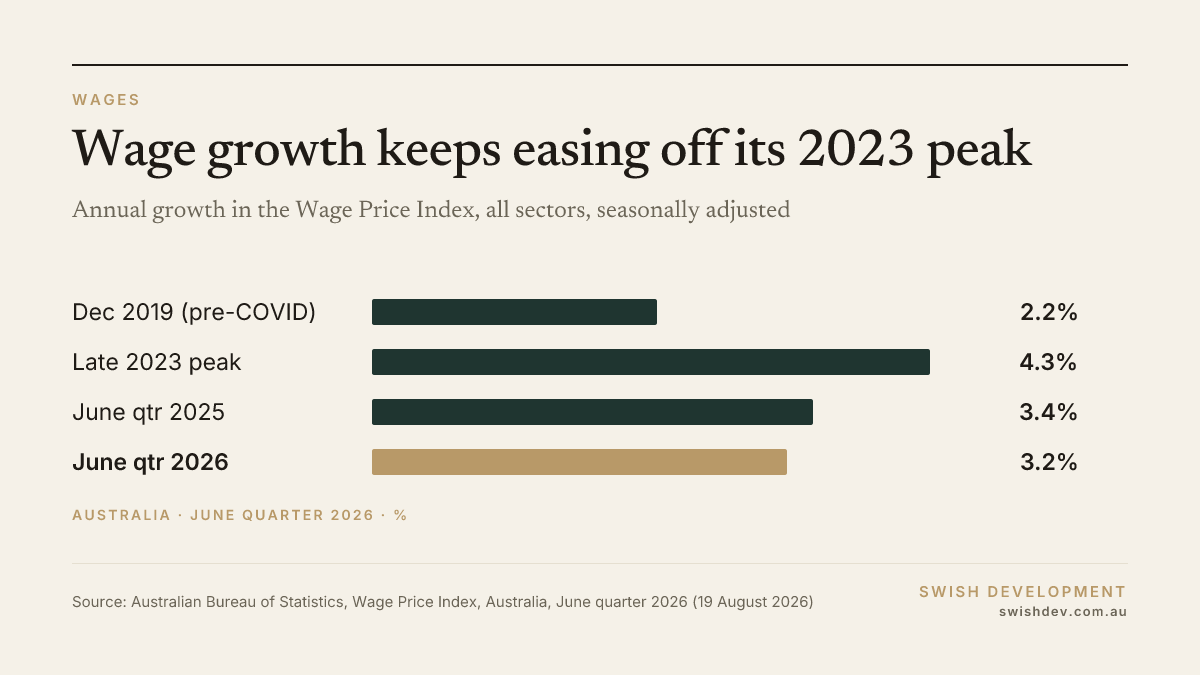
The ABS released the June quarter Wage Price Index on 19 August. Wages rose 0.8% for the quarter in seasonally adjusted terms and 3.2% over the year, down from 3.4% at the same point last year.
The sector split is where the detail sits. Private sector wages rose 3.1% annually, easing from 3.4% a year earlier. Public sector wages rose 3.4%, down from 3.7%. That is the sixth consecutive quarter in which public sector wage growth has run ahead of the private sector.
Queensland recorded 0.6% for the quarter and 3.4% over the year in original terms, above the national figure.
Context matters on the level. Wage growth is well below the 4.3% peak of late 2023, but still above the 2.2% the ABS recorded in December 2019, before COVID. This is a normalisation rather than a collapse. It is also running below inflation: the ABS put annual CPI at 3.8% in its June print, so wages are losing ground in real terms even while they grow.
Two things follow for anyone running a project. Labour is the largest single line in a build programme, and 3.1% private sector growth is a materially easier escalation assumption than the 4%-plus of two years ago. On the other side of the feasibility, wage growth is what ultimately sets buyer borrowing capacity, and a buyer whose income is growing at 3.1% against 3.8% inflation is not gaining ground on a deposit or a serviceability assessment.
Employment falls 16,000 and unemployment lifts to 4.5%
The ABS Labour Force release for July, published 20 August, recorded a fall of 16,000 in employment and a rise of 4,000 in the number of unemployed. The seasonally adjusted unemployment rate rose to 4.5%.
Both participation measures went the same way. The participation rate fell 0.2 percentage points to 66.9% and the employment-to-population ratio fell 0.2 percentage points to 63.9%. Hours worked fell by 12 million across the month, split between 7 million fewer full-time hours and 5 million fewer part-time hours.
A single month is not a trend, and the falls are small against a labour force of that size. But the direction is consistent across every measure in the release, which is less common than a headline move on its own.
The reason this matters beyond the macro pages is sequencing. The Reserve Bank held at 4.35% on 11 August and explicitly kept the option of a further rise on the table if upside risks materialised. The two prints since are the first hard evidence on whether those risks are showing up, and neither supports a tightening case. Wage growth is easing, not accelerating, and the labour market is loosening rather than tightening.
That does not make a cut the base case. It does mean the balance of evidence since the hold has moved away from the scenario the Board was guarding against, and the next meeting will be read against these two releases.
The June quarter Wage Price Index and the July Labour Force release are the fresh prints this week. Everything else in the table sits at its most recent released value.
The next cluster of releases falls after this issue goes out. The monthly CPI indicator for July and the preliminary June quarter Construction Work Done both release on 26 August, and private capital expenditure follows on 27 August. None of them are anticipated here. APRA’s June quarter property exposures, which carry the serviceability and loan-to-value detail, are not due until September.
Housing credit still reflects the June quarter, when new dwelling loan commitments fell 5.4% nationally and Queensland investor loans fell 10.1%. Cotality’s July index, released 3 August, remains the latest read on values, with national dwelling values down 0.7% and Brisbane down 0.6%.
Sunshine Coast
One of the largest undeveloped blocks in Maroochydore has gone to market. The site at 7 and 11 Southern Drive and 10 Carnaby Street runs to more than 6,050 square metres and is being offered through an expressions of interest campaign, described by the selling agents as one of the last significant development-ready sites in the town. It is being sold by a Sydney family who bought it for less than $4 million in 2004 and have held it vacant since. The campaign has drawn local, national and international interest (Sunshine Coast News, 18 August).
The planning position is the part worth reading closely. The land is principal centre zoned and currently carries a 25 metre height limit, but could be scaled to 35 metres under the draft Sunshine Coast planning scheme. The proposed Maroochydore public transport station will sit alongside it.
That combination, a large amalgamated holding whose permitted height depends on a scheme still in draft, is a live example of something the whole Coast market is now pricing. Buyers are being asked to pay today for height that the draft scheme has proposed and the adopted scheme has not yet delivered.
The same question ran through a council report published the same week. Council planning officers recommended approval of an amended Crowne Plaza proposal at 15 to 19 Ocean Street, in which Felix Capital sought to lift the approved building from 13 storeys and 47 metres to 14 storeys and 55.25 metres, adding six dwellings to take the residential component from 24 to 30. Officers found the taller form would not be out of place given the pattern of building heights along Ocean Street, and that the affected views are not identified as significant views under the Maroochydore and Kuluin Local Plan Code. The recommendation went to the council’s ordinary meeting on 20 August (Sunshine Coast News, 18 August).
Read together with the height applications covered last week, the Coast now has a consistent pattern: applicants testing adopted limits against the direction of a draft scheme, and officers assessing them on surrounding built form rather than the number in the table. For small operators the practical implication is about evidence. An argument built on the established and emerging character of the immediate street is doing more work in these assessments than an argument built on the draft scheme alone.
Wage growth cuts both ways on a feasibility.
Private sector wages grew 3.1% over the year to June, down from 3.4%. That eases the labour escalation assumption in a build programme, and it simultaneously slows the growth in buyer borrowing capacity that carries the sales side. A feasibility that takes the cost relief without adjusting the revenue line has only applied half the print.
Real incomes are still going backwards.
Wage growth of 3.2% sits below the 3.8% annual CPI the ABS published for June. Buyers are not recovering purchasing power, which is consistent with first home buyer commitments being flat over the year and investor commitments falling 10.1% in Queensland last quarter. Deposit accumulation is getting harder, not easier.
The tightening case has weakened since the hold.
The Reserve Bank kept an explicit rise on the table on 11 August. Since then wage growth has eased and employment has fallen, with participation and hours worked falling alongside. Neither print supports the upside-risk scenario the Board named. This is not a case for pencilling in a cut, but it is a reason to stop treating a further rise as the live risk in a 12 to 18 month holding-cost assumption.
Draft-scheme height is being priced before it is adopted.
The Maroochydore site carries a 25 metre limit today and a proposed 35 metres under a scheme still in draft. Any bid that pays for 35 metres is buying a planning outcome that has not been made. That is a real option with real value, but it belongs in a feasibility as a contingent upside, not as the base case yield.
Public sector wages have outrun private for six straight quarters.
Public sector growth of 3.4% against private 3.1% is now a two-year pattern, not a quarter’s noise. For trades competing with government infrastructure programmes for the same labour, that gap is the mechanism by which a pipeline of public work prices private residential builders out of their own subcontractors.
What buyers say a data centre is worth to them
A national survey has put a number on something the Sunshine Coast has been arguing about for a month. Primara Research, commissioned by the Australian software company Airteam, surveyed 1,000 people and found 83% would walk away from a property near an AI data centre, and that those who would still consider one wanted an average discount of $35,000 before doing so. Noise and air pollution concerned 80%, and pressure on water supply concerned 78%. The reluctance ran hardest among baby boomers at 92.6% and softest among millennials at 75% (Sunshine Coast News, 20 August).
Set that against what is actually happening on the ground here, and the picture gets more interesting. REIQ Sunshine Coast zone chair Mark McGill said he had not seen property prices fall around the existing SC1 facility, and that he had sold Maroochydore City Centre apartments to buyers who specifically wanted to be close to technology infrastructure. In his read, connectivity is a value-add, and internet quality is a genuine driver.
Both things can be true, and the gap between them is the useful part. Survey respondents are answering an abstract question about a category, with the phrase “AI data centre” doing a lot of work. Buyers in a live campaign are choosing between specific properties at specific prices, next to a facility they can see is quiet. Stated preference and revealed preference diverge, and they diverge most where the thing being asked about is unfamiliar.
The honest position is that nobody has enough transaction evidence yet. SC1 is one facility in one CBD, and the $200 million SC2 that prompted last week’s land-supply argument does not open until the first half of 2027. Queensland has no local paired-sales study of the kind that would settle it.
For anyone acquiring near Maroochydore, that uncertainty is the thing to price rather than either headline. A $35,000 stated discount is not a valuation input, and a single agent’s experience at one facility is not a market. What both do establish is that this is now a question buyers are asking, which means it will start showing up in campaign feedback and finance valuations before it shows up in any index. Worth knowing which way your own buyers lean before the marketing budget is committed, rather than after.
27 August 2026: ABS Private New Capital Expenditure, June quarter, and Regional Population by Age and Sex, 2025.
1 September 2026: Queensland Housing Code three-year council adoption transition opens, replacing Queensland Development Code parts 1.1 and 1.2.
September 2026: APRA quarterly ADI property exposures for the June quarter, carrying the serviceability, loan-to-value and debt-to-income detail.
27 September 2026: Consultation closes on the draft Victoria Park precinct legacy plan.
Subscribe
Not yet on the list?
The SEQ Development Brief lands Tuesday mornings — the big residential development moves across South-East Queensland's twelve councils, plus the occasional update on what we're building. Free.