The SEQ Development Brief
Swish Development
Housing is what is left of the inflation problem
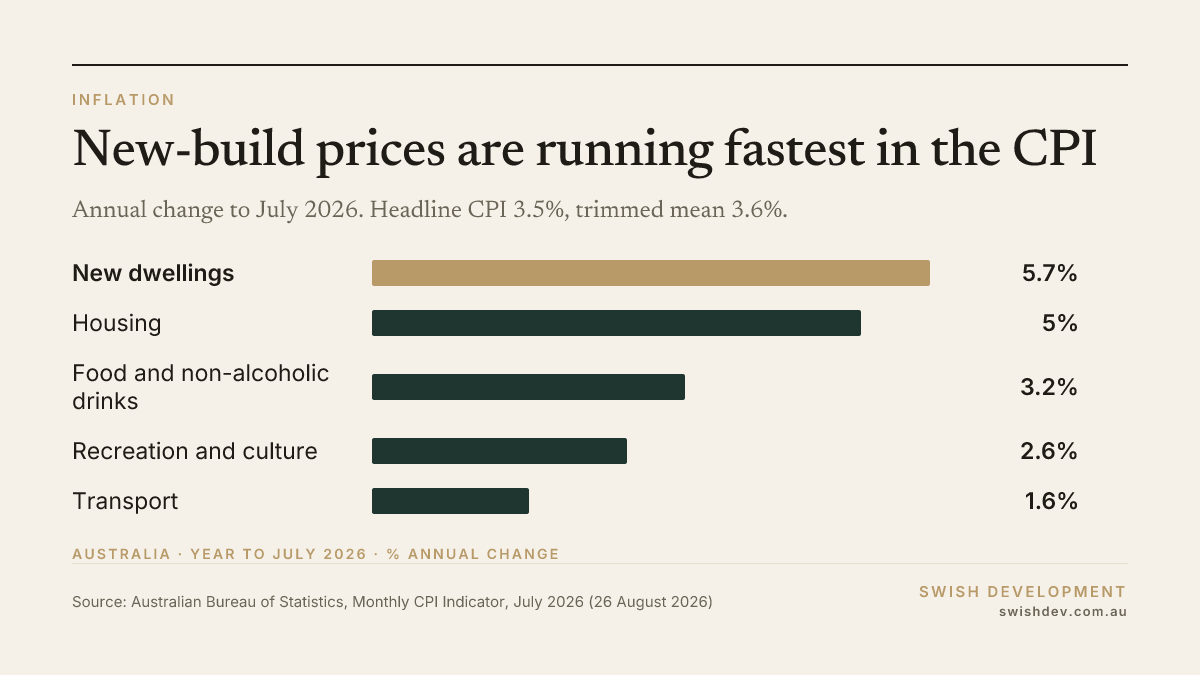
The monthly CPI indicator rose 3.5% in the 12 months to July 2026, down from 3.8% in the year to June (ABS, released 26 August). The trimmed mean did not move. It held at 3.6%, the same reading as June.
The composition is the part worth reading. Housing was the largest contributor to annual inflation at 5.0%, and the ABS attributes that to new dwellings, where prices rose 5.7% over the year as builders passed on higher material and labour costs. Food and non-alcoholic drinks rose 3.2%. Recreation and culture rose 2.6%. Transport rose 1.6%, up from 0.1%, after automotive fuel jumped 7.5% in the month on higher global oil prices and the partial expiry of federal fuel excise relief. Meals out and takeaway ran at 4.5%. In original terms the index rose 1.0% for the month.
For anyone pricing a build, the 5.7% line is the one that counts. It is consistent with the Queensland producer price data covered in this brief on 3 August, where house construction output prices ran 8.0% over the year to June. Two different series, same direction.
It also explains why the Reserve Bank has not shifted. The board held the cash rate at 4.35% on 11 August, unanimously, and kept the option of raising it open. A trimmed mean that will not go below 3.6% is the reason, and headline inflation easing on fuel and food does nothing about it. The next decision is 29 September.
Builders took work off the engineering trades
Total construction work done fell 2.1% to $82.5b in the June quarter, seasonally adjusted, and was 2.7% higher than a year ago (ABS, released 26 August). Underneath that flat top line, the two halves of the industry went opposite ways.
Building work done rose 1.3% to $45.8b for the quarter and 10.0% over the year. Residential building rose 1.7% for the quarter and 9.1% for the year. Non-residential building rose 0.5% and 11.5%. Engineering construction fell 6.0% to $36.7b and now sits 5.1% below where it was in June 2025.
Queensland ran ahead of the national line. Construction work done in the state reached $16,955.9m for the quarter, up 1.1% on March and 7.9% on the June quarter of 2025.
The read for a small developer is about trade availability rather than headline growth. Engineering has been the competitor for concreters, formworkers, crane crews and civil subcontractors right through the infrastructure cycle, and it has been winning. An engineering book falling 5.1% over the year while residential building runs 9.1% higher is the first quarter in this cycle where the labour pool has started moving back toward housing. That shows up in tender coverage before it shows up in price. It is worth testing at the next round of subcontractor quotes rather than assuming last year’s coverage.
Two prints landed on 26 August and both cut the same way: the cost of building a house is rising faster than almost anything else in the economy, and the volume of house building is rising with it.
The Cotality figures still carry July. National dwelling values fell 0.7% in July, the largest monthly decline since December 2022, with Brisbane down 0.6% (Cotality, 14 August). Homes took a median 35 days to sell over the three months to July. National rents grew 5.9% over the year and gross yields sat at 3.7%. The August index releases after this issue goes out, so the table below carries July.
Building approvals are in the same position. The July print releases on 1 September, so the table carries June, when total dwelling approvals rose 7.2% to 18,328 seasonally adjusted and Queensland led every state at 33.4% (ABS, released 30 July). Private sector houses were 10,631, up 15.8% on a year ago.
The presale test is the number that moves
APRA’s credit risk capital consultation closes on 7 September. Most of the package is about infrastructure and corporate lending. One piece of it is the most consequential regulatory item in the queue for residential developers, and it has had almost no coverage.
At issue are the criteria that decide whether a land acquisition, development and construction exposure attracts a 100% risk weight rather than 150% (APRA, 29 June). Under the standard as it stands, a residential ADC exposure qualifies for the lower weight only where qualifying presales cover 100% of total debt. APRA is proposing to cut that threshold to 50% (Broker News, 29 June). For build-to-rent, a pre-lease test would replace the presale test. The proposed effective date is 1 April 2027, with the changes finalised in the second half of this year.
Risk weight is not a rule about what a bank may lend. It is a rule about how much capital the bank has to hold behind the loan. At 150%, a development facility consumes half again as much capital as the same facility at 100%, and that cost comes back as margin, as line fees, and as a credit committee that looks harder at a deal presold on paper but only just. Halving the qualifying presale threshold forces no bank to lend anything. It changes the price of saying yes, and it changes it most for the deals that sit just under the line.
APRA chair John Lonsdale framed the package as making risk weights “more granular and risk-sensitive” without compromising prudential objectives. The practical effect for a 10 to 40 dwelling project is narrower and more useful than that: the presale hurdle, not the LVR, is usually what stops those deals with a major bank, and it is the reason so many of them end up with a non-bank at several hundred basis points more. If the 50% test survives consultation, the gap between what a major will fund and what a private lender will fund narrows for exactly the size of project most readers of this brief are running.
None of that is settled. It is a consultation paper with a 7 September deadline and an April 2027 start, and prudential proposals get amended between draft and final. Two things are worth doing before then. Check what presale coverage your current lender actually requires against what the standard requires, because they are frequently not the same number and the bank’s own policy floor may not move even if APRA’s does. And if a feasibility has been sitting in the drawer because the presale coverage did not stack, the assumption behind that decision has a review date on it now.
This is a report on what a regulator has proposed and what it would mean, not a recommendation on any facility or lender.
Brisbane
Brisbane City Council adopted its More Homes, Sooner low-medium density amendment on Tuesday 18 August (ABC, 23 August). It is the largest change to Brisbane’s small-lot rules in years, and it takes the minimum lot size in the low-medium density residential zone from 260sqm to 120sqm where a proposal meets design and built form criteria assessed at subdivision stage.
The detail matters more than the headline number. Small lot housing is capped at three storeys and 11.5m. Multiple dwellings can reach four storeys and 14m in identified Key Locations, on a minimum 800sqm. Dual occupancy has a 400sqm floor. Lots under 180sqm carry a 55% site cover limit and a 70% maximum impervious area, which is what stops the 120sqm headline from translating into a 120sqm lot with a house on all of it. In the low density residential zone, the walking distance to a shopping centre that allows subdivision to 300sqm lots widens from 200m to 300m (Brisbane City Council).
The amendment applies to about 14% of Brisbane’s residential land, all of it already close to transport, shops and services, and the council puts the potential at around 6,000 additional homes. Industry response was that it does not go far enough: the Housing Industry Association’s Queensland office argued minimum allotment sizes should be scrapped outright and the approach taken statewide.
The 120sqm figure will be the one quoted. The site cover and impervious area limits are the ones that will decide whether a given block works, and they are assessed at subdivision rather than at a later stage, which means the design work has to be done before the reconfiguration application rather than after it.
Gold Coast
Arada Group has taken a Broadbeach site opposite the Gold Coast Convention Centre for a $2b twin-tower residential project, announced 20 August. The scheme carries 952 residences across one to three bedroom apartments plus about 1,200sqm of ground floor retail and hospitality, with Roberts Co as builder and completion targeted ahead of the 2032 Games. No approval status was stated in the announcement.
It is the UAE developer’s first move outside New South Wales and its largest Australian commitment. The relevant signal for smaller operators is not the tower itself. It is that offshore capital is still pricing Gold Coast apartment land at a level that supports a $2b programme, and that a tier-one builder is willing to take head contract risk at that scale on Gold Coast apartment stock. Both are pricing inputs for anyone valuing a smaller site in the same catchment.
Sunshine Coast
The Department of Transport and Main Roads has confirmed the Birtinya to Mountain Creek corridor and the location of the Mountain Creek station for The Wave (Sunshine Coast News, 24 August). Stages 1 and 2, heavy passenger rail between Beerwah and Birtinya, hold $5.5b in joint state and federal funding. Stage 3, metro-style vehicles between Birtinya and the airport via Maroochydore, still has no construction funding confirmed.
The corridor decision has a direct property consequence. In July, owners of 81 previously affected properties were told their land would no longer be required. Other Mountain Creek properties remain in the frame, and the proposed station and its infrastructure now fall inside the Buderim Resource Recovery Centre, with environmental site plans indicating the station car park could take more of the green waste area. Sunshine Coast Council says it is working with the state on displacement impacts and has not published a contingency.
For anyone holding or looking at stock near the corridor, this is the point where the discount stops being generic. Sites released from the acquisition footprint have had an encumbrance lifted. Sites near a confirmed station have a catchment argument that was speculative six months ago. Final design and the wider station precinct are still under assessment, so the boundary is not yet fixed.
The presale test outranks the LVR.
APRA’s proposal to cut the qualifying presale threshold for residential ADC exposures from 100% to 50% of total debt (APRA, 29 June) targets the constraint that actually binds on small and mid-sized projects. Loan-to-value ratios get the attention in feasibility discussions; presale coverage is what sends the deal to a non-bank. Submissions close 7 September and the proposed start is 1 April 2027, so this is a 2027 planning input, not a 2026 one.
Build cost is now the inflation story.
New dwelling prices rose 5.7% over the year to July while headline inflation ran 3.5% (ABS, 26 August). Any feasibility carrying a build-cost escalation assumption below the high fives is running behind the published data, and the Queensland producer price series at 8.0% to June suggests the gap is wider here than nationally.
Trade capacity is rotating back toward housing.
Engineering construction work done fell 5.1% over the year to June while residential building rose 9.1% (ABS, 26 August). The infrastructure cycle has been the main competitor for civil trades and formwork crews. This is the first quarterly print where that competition eased, and tender coverage is where it will surface first.
Brisbane just moved the small-lot floor, with conditions.
The 260sqm to 120sqm cut applies across roughly 14% of Brisbane’s residential land (ABC, 23 August), but the binding constraints are the 55% site cover and 70% impervious limits on lots under 180sqm, both assessed at subdivision (Brisbane City Council). The yield gain is real and it is smaller than the headline lot size implies.
Corridor confirmation reprices land in both directions.
The Wave’s Birtinya to Mountain Creek alignment is now fixed and 81 Sunshine Coast properties were released from acquisition in July (Sunshine Coast News, 24 August). Removal of an acquisition overhang and confirmation of a station catchment are separate events with opposite effects on different sites, and both happened at once.
The rate outlook is a housing-cost outlook.
The Reserve Bank held at 4.35% on 11 August with a tightening bias intact, and the July trimmed mean stayed at 3.6%. The component holding it there is housing at 5.0%. Rate relief for buyers and rate relief for builders are now the same problem, which makes a September cut implausible and puts the next real decision point at 29 September.
1 September 2026: ABS Building Approvals, July 2026.
2 September 2026: ABS Australian National Accounts, June quarter 2026, with national accounts trend estimates reinstated.
7 September 2026: Submissions close on APRA’s credit risk capital consultation, including the residential ADC presale proposal.
29 September 2026: RBA Monetary Policy Board decision, the first since the 11 August hold.
30 September 2029: Narrow-lot exemption from liveable housing requirements expires under the Modern Homes Standards.
37 Wrigley St
Settlement on our Maroochydore site lands on 3 September, two days after this issue goes out. The site is 607sqm in the low density residential zone and the plan is a duplex.
Where things sit: the development application is with Sunshine Coast Council, the builder is selected, and the building contract is in negotiation. Nothing about the sequence has been unusual, which is worth saying because the interesting parts of a project like this are rarely the parts that go wrong.
Subscribe
Not yet on the list?
The SEQ Development Brief lands Tuesday mornings — the big residential development moves across South-East Queensland's twelve councils, plus the occasional update on what we're building. Free.