The SEQ Development Brief
Swish Development
The Reserve Bank put a rise back on the table itself
Assistant Governor Sarah Hunter told the AFR Property Summit on 8 September that if inflation runs stronger than the Bank expects, the Board “may well have to raise interest rates” (RBA, 8 September). That evening Deputy Governor Andrew Hauser told ABC 7.30 that inflation is the one big problem facing the Bank and that inflation is too high. He declined to predict the September decision, pointing out that nine people vote on it (RBA, 8 September).
Westpac moved the same afternoon. Chief economist Luci Ellis made a November rise to 4.60% the bank’s base case, citing a more resilient household sector and spillovers from the data centre boom (ABC, 8 September). Westpac was the last of the big four to shift. NAB expects the rise on 29 September, ANZ, Commonwealth Bank and Westpac expect November, and all four have the cash rate peaking at 4.60% (Aussie, 9 September).
Markets went further. The ASX RBA Rate Tracker put the chance of a September rise at 72% on 11 September, up from 54% at the start of the month (FXStreet, 11 September). The same day an oil price spike pushed the three-year government bond yield up 18 basis points to 5.05%, and the 10-year yield reached 5.256%, its highest level since mid-2011 (Reuters via Business Recorder, 11 September). Citi now expects two more rises this year, taking the cash rate to 4.85%. Other measures reported the same day put the odds higher still, so treat any single probability as a reading on one instrument on one day.
The Bank’s read on housing is the part to keep. Hunter expects dwelling construction activity to ease through the back half of the forecast period, in 2027 and 2028. Hauser described a floor under house prices set by the supply shortfall and noted prices remain about 3% higher than a year ago.
For a developer, the cost of money has moved ahead of the Board. Facilities priced off bond and swap rates carry this week’s repricing now, whatever happens at 2:30pm on 29 September.
Construction went from the strongest industry to negative in a month
Business conditions in construction fell from +17 in July to -5 in August, seasonally adjusted (NAB, 8 September). In July construction was the strongest of the eight industries NAB tracks. No other industry fell as far in August. Construction confidence dropped from -1 to -9.
The national picture turned with it. Business conditions fell five points to -1, the lowest reading since August 2020 and the first negative print in six years, driven by a 10-point fall in profitability to -9.
Costs are the pressure point. Purchase cost growth rose 1.2 percentage points in construction against small declines in most industries, and NAB named construction as an industry to watch given dwelling prices, construction costs and developer solvency. In trend terms construction conditions are still +9, so one month is a warning rather than a verdict.
Queensland business confidence fell eight points to -7, the largest fall of any state, and Queensland conditions slipped from +3 to -1.
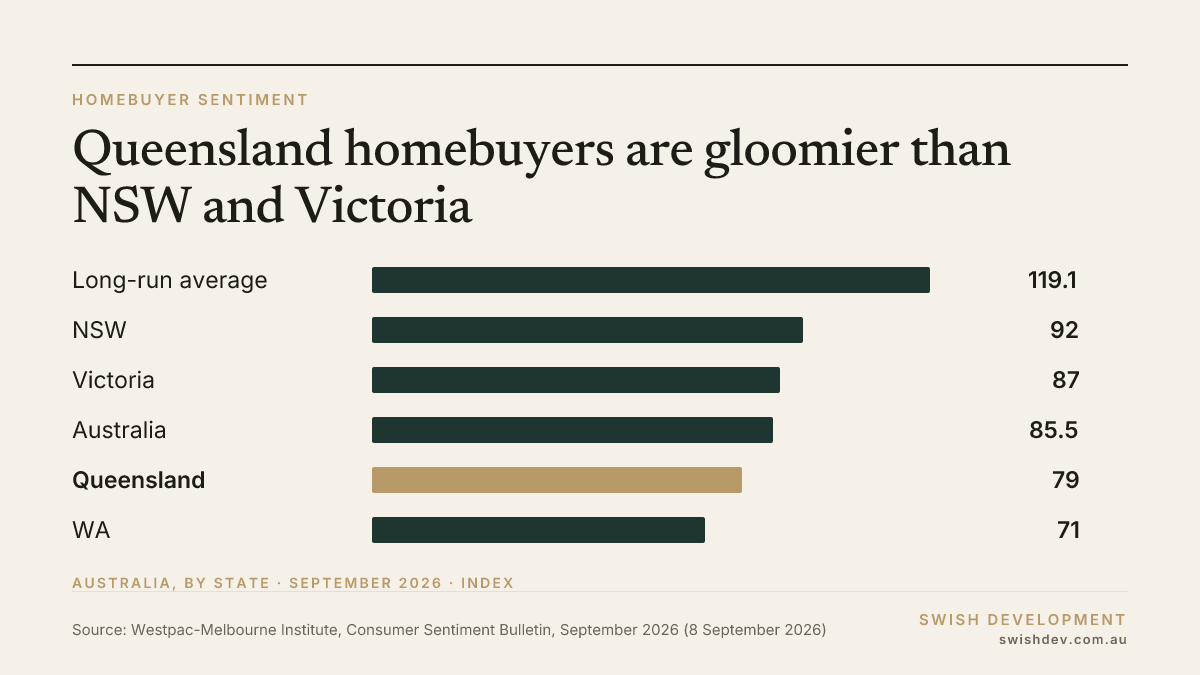
Households are reading the same signals. The Westpac-Melbourne Institute survey, run from 31 August to 3 September, found job loss fears rose significantly more among construction and hospitality workers than elsewhere (Westpac-MI, 8 September). The time to buy a dwelling index fell 10.7% to 85.5, giving back all of August’s gain. Queensland buyer sentiment sat at 79, below New South Wales at 92 and Victoria at 87, the states where prices have fallen furthest.
Put builder margins under pressure next to buyers pulling back, and the exposure sits in fixed-price build contracts signed before August and in presale campaigns launching into the December quarter.
Queensland’s dwelling values held up through the June quarter even as the national figure turned. The total value of Australia’s dwellings fell 0.3%, or $34.1b, to $12,688.9b, the first fall since the September quarter 2022 (ABS, 8 September). The national mean dwelling price fell $8,200 to $1,100,400. Mean prices fell only in New South Wales (down $32,700), Victoria (down $19,600) and the ACT (down $13,300). Queensland’s rose $15,800 to $1,130,600, now above Western Australia’s $1,123,700 and second only to New South Wales at $1,304,900.
That is a June quarter number. The monthly data since has been weaker, with Brisbane values down 1.0% in August on Cotality’s index, the steepest monthly fall of this cycle (Cotality, 1 September).
The auction market is where Brisbane looks softest. Brisbane cleared 26.0% of 131 auctions in the week ending 6 September, the lowest of the capitals (Cotality, 10 September). Nationally 49.3% of 1,431 auctions cleared, against 70.0% a year earlier, and 480 homes were passed in against 245 withdrawn. Brisbane had 169 auctions scheduled for the following week, up 29.0%.
Consumer sentiment fell 5.2% to 84.4 in September and sits 11.6% below a year earlier (Westpac-MI, 8 September). The mortgage rate expectations index rose 7.3% to 170.4, and 64% of consumers now expect mortgage rates to rise over the next year, up from 59% in August.
Bathla’s lenders have stopped moving as a group
Three weeks into the Bathla Group administration, the lenders have split. The first creditors’ meeting on 4 September put known debts at about $3.4b: $3.08b owed to secured lenders, $145m to the ATO, $42m in land tax, $130m to other unsecured creditors and $4m to employees (ABC, 4 September). The administrators valued the 219 sites at about $4.9b and stressed that figure is not cash available to creditors.
On 7 September five lenders (La Trobe, PAG, Centuria Bass, Ray White Capital and one unnamed) agreed to put in between $3m and $5m to keep construction going for two weeks. Fourteen sites continue and about 213 of roughly 350 staff were stood down (ABC, 7 September).
Five out of about 40 lenders is the number that matters. By 12 September 360 Capital, Ray White Capital, Leda, Balmain and Woodbridge had appointed receivers or taken control of individual projects. A proposal to take on about 25 land-only sites worth around $1b was withdrawn on Friday 11 September after the parties could not agree on structure, fresh valuations and the founder’s continued involvement. NSW Treasurer Daniel Mookhey said the state would protect buyers and keep construction going where it could, but would not use taxpayer money to bail out private credit lenders (ABC, 12 September).
360 Capital Mortgage REIT’s update shows how an individual lender plays it. The trust is recovering about $31.7m across four loans, with receivers selling 162 properties. It also holds an $8.5m subordinated investment in 72 apartments nearing completion, where the plan is to secure occupancy certificates so existing presale contracts settle (360 Capital via ShareCafe, 10 September).
The regulators see no system problem. The Council of Financial Regulators said on 3 September that tighter financial conditions had contributed to falling housing prices, that borrower stress remained limited, and that it had discussed private credit markets without saying more (CFR, 3 September). Hunter said the Bank does not see systemic signs of stress in private credit.
Both can be right for the system and beside the point for a project.
When a group fails, what happens to each project depends on the lender sitting over it, not on the group. A lender holding a nearly finished building with presales has every reason to finish it. A lender holding bare land has every reason to sell. For an SEQ developer carrying non-bank debt, the Bathla sequence is a reminder to know how your own facility would behave in a stress: who holds security over what, who can step in, and whether the funder’s incentive is to complete or to exit. For a presale buyer or a trade on someone else’s project, the same question applies to that project’s lender.
This is a report on what lenders, funds and regulators have done and said. It is not advice on any facility, fund, lender or investment.
Brisbane
The state has chosen five builders and developers for about 2,200 homes across five riverfront sites at Northshore Hamilton (Queensland Government, 6 September). The 6.1ha of land at 60 to 102 MacArthur Avenue drew 18 proposals in eight weeks. Lancini takes about 484 homes plus a hub with a full-line supermarket, Red & Co about 440, GRAYA about 435 plus a 50-bed hotel, Joe Adsett Developments about 430 and Greyburn about 402. The package includes 21,600 square metres of retail, dining and commercial space. The state is funding $154m of roads, sewer and water first, construction starts in 2028 and the first residents are expected in 2031.
In South Brisbane, TRK Property Group paid $20m for a 1,917 square metre site at 176 Montague Road through Colliers (Brisbane Development, 8 September). A 20-storey, 161-apartment tower by COX Architecture was lodged with Brisbane City Council on 28 July and is under assessment. The site sits near Lendlease’s former Visy site, planned for more than 4,000 homes.
Sunshine Coast
Stockland has lodged a Stage 2 operational works application for Birtinya Central, the 28ha town centre planned for up to 2,600 homes on Lake Kawana (Sunshine Coast News, 9 September). Stage 2 extends The Avenue and Central Boulevard and creates four development lots and three park lots, with a separate $2.5m landscaping application. Building heights are planned at eight to 15 storeys, with at least six sites capped at 12. Civil works are expected to start late in 2026 subject to approval, with first residents and commercial tenants expected in 2029.
North of the Maroochy River, Stockland’s 104ha, 450-home Twin Waters community sold out its July and August land releases, with lots from $1.15m to more than $1.4m and averaging about 700 square metres (Sunshine Coast News, 11 September). The next release is expected in October.
Moreton Bay
City of Moreton Bay has released a draft Future Directions Report for about 1,020ha at Narangba East, covering future housing and employment land, environmental corridors and retained rural residential areas (City of Moreton Bay, 7 September). A temporary local planning instrument holds the area, and state conditions require housing outcomes and a finished planning scheme amendment before that instrument expires in June 2028. Feedback closes on 9 October.
Ipswich
Ipswich City Council has put a draft Western Growth Corridor Structure Plan out for comment, covering Rosewood, Walloon and Thagoona, where the population is forecast to grow from about 10,000 to almost 59,000 by 2041 (Ipswich First, 10 September). The work is funded by $500,000 from the federal Housing Support Program. Feedback closes on 19 October and the final plan is due in 2027.
Redland
Submissions on the proposed development scheme for the Southern Thornlands PDA close on 15 September (Economic Development Queensland). The 890ha area is planned for about 8,000 homes and 24,000 residents, supported by $544m in catalyst infrastructure: $256m for roads and transport, $137m for sewer, $29m for water and $93m for open space and community facilities.
Scenic Rim
Scenic Rim Regional Council refused two retirement proposals on Tamborine Mountain on 26 August, both against officer recommendations to approve (Beaudesert Bulletin, 26 August). Living Gems’ 141-dwelling over-50s community at 30 Kidd Street was refused unanimously after 551 properly made submissions. A retirement facility at 24 to 34 MacDonnell Road was refused four votes to three after 125 submissions. Councillors cited conflict with the planning scheme and pressure on local medical services and roads.
The cost of money moved first.
The three-year bond yield reached 5.05% and the 10-year its highest level since mid-2011 on 11 September, before the Board has changed anything (Business Recorder, 11 September). Any facility priced off those markets has already repriced. A feasibility that waits for 29 September to update its finance cost is already out of date.
Builder margins are the next weak point.
Construction purchase cost growth rose 1.2 percentage points in August as the industry’s conditions fell 22 points, and NAB named developer solvency as a reason to watch the sector (NAB, 8 September). Builders absorbing costs they cannot pass on are the ones who come back to renegotiate a fixed-price contract. Builder counterparty checks belong in the programme now, not at practical completion.
Queensland’s price data lags its buyer mood.
Queensland’s mean dwelling price rose $15,800 in the June quarter and New South Wales fell $32,700 (ABS, 8 September), yet Queensland buyer sentiment now sits at 79 against New South Wales at 92, and Brisbane cleared 26.0% at auction (Westpac-MI and Cotality). Price series report what already settled. Sentiment and clearance rates are the leading read for a presale campaign launching this quarter.
Northshore is timed to land after the dip.
The state is paying for $154m of trunk infrastructure at Northshore Hamilton first, with construction from 2028 and residents from 2031 (Queensland Government, 6 September). The RBA expects dwelling construction to ease in 2027 and 2028. Handing 2,200 homes to five mid-sized builders on that timeline puts their starts on the far side of the slowdown, when trades should be easier to secure.
Three growth fronts are open at once.
Southern Thornlands (8,000 homes, submissions close 15 September), Narangba East (1,020ha, feedback to 9 October) and Ipswich’s western corridor (forecast to reach almost 59,000 people by 2041, feedback to 19 October) are all in consultation together, alongside the draft State Planning Policy to 26 October. The rules that shape land values there for a decade are being written in the next six weeks, and the window to be on the record is short.
The data centre boom is bidding for your electricians
The biggest AI effect on SEQ housing this month has nothing to do with software. The Powering Skills Organisation estimates Australia needs 72,000 more electricians, technicians and related trades by 2030, up from a 42,000 shortfall forecast a year ago (ABC, 2 September). Data centre construction is projected at about $150b by the end of the decade and will need 13,000 energy trades workers on its own. There were 162 data centres operating as of March 2026, with another 130 proposed. The same workers are needed for the 1.2 million homes in the Housing Accord.
The Reserve Bank is hearing the same thing. Hunter told the AFR Property Summit on 8 September that the Bank has anecdotes of labour being drawn into these projects and away from other parts of the construction sector (RBA, 8 September). Westpac cited spillovers from the data centre boom as one reason it moved to a November rate rise (ABC, 8 September).
So AI reaches a duplex on the Sunshine Coast twice: through the electrical subcontract and through the interest rate. The report has no Queensland breakdown, so this is a direction rather than a local measurement. A data centre contractor paying for certainty will outbid a two-dwelling job, and electrical is a critical-path trade that can hold up practical completion. On any build contract being priced now, it is worth knowing whether the electrical package is fixed or provisional, and for how long the price holds.
17 September 2026: ABS National, state and territory population, March quarter 2026, including interstate migration to Queensland.
18 September 2026: Governor Michele Bullock and Deputy Governor Andrew Hauser appear before the House of Representatives Economics Committee.
24 September 2026: ABS Labour Force, August 2026.
29 September 2026: RBA Monetary Policy Board decision, 2:30pm.
30 September 2026: ABS Consumer Price Index and Building Approvals, both for August 2026.
1 October 2026: RBA Financial Stability Review.
7 October 2026: ABS Building Activity, June quarter 2026, covering commencements and completions.
9 October 2026: Narangba East draft Future Directions Report feedback closes.
13 October 2026: NAB Monthly Business Survey, September 2026.
19 October 2026: Ipswich Western Growth Corridor draft structure plan feedback closes.
26 October 2026: Consultation on Queensland’s draft State Planning Policy closes.
3 November 2026: RBA Monetary Policy Board decision and Statement on Monetary Policy.
Subscribe
Not yet on the list?
The SEQ Development Brief lands Tuesday mornings — the big residential development moves across South-East Queensland's twelve councils, plus the occasional update on what we're building. Free.