The SEQ Development Brief
Swish Development
The Reserve Bank stopped hedging
Governor Michele Bullock and Deputy Governor Andrew Hauser appeared before the House of Representatives Standing Committee on Economics on Friday 18 September. Bullock told the committee that the upside inflation risks the Bank flagged in August are materialising, and that the Board is weighing whether it has a tight enough policy setting (ABC, 18 September).
The specific worry is fuel. Bullock described a world facing higher oil prices for longer, and said businesses are now more inclined to pass cost increases through rather than absorb them (InvestingLive, 18 September). That is the mechanism that turns an external price shock into domestic inflation, and it is the reason a central bank stops treating a fuel spike as something to look through.
Hauser made a separate point that matters more to a ten year feasibility than to next month’s repayment. He said rates are probably rather closer now to a sensible level of long term global real interest rates than they were a year or two ago, and that the decade between the financial crisis and COVID was the aberration. Read plainly, that is the Bank saying the current level is closer to normal than to restrictive.
The Board meets on 28 and 29 September, with the decision at 2:30pm on the Tuesday. The cash rate is 4.35%. A 25 basis point move would take it to 4.60%.
No probability is printed here for this meeting. Market-implied odds were reported anywhere between 66% and 95% within the same week, depending on the measure and the day, and they cannot be reconciled to a single figure. What is not in dispute is the direction of the language. In August the Bank flagged risks. In September it says they are materialising.
Last week’s issue covered the Bank putting a rise back on the table. This is the next step: not whether rates go up once, but where the Bank thinks the resting level is.
Investors took more of a record lending quarter
APRA released its quarterly authorised deposit taking institution property exposures for the June quarter on 17 September. Banks funded $200.5 billion of new residential mortgage lending over the quarter, up 6.8% on a year earlier (APRA, 17 September).
The composition is the interesting part. Investors took 35.6% of new lending, up 1.48 percentage points over the year, while the owner occupier share fell 1.72 points to 61.9%. New lending at a debt to income ratio of six or more edged up to 5.6%, but the average hides the split: owner occupiers sat at 3.7% while investors sat at 8.9%. Lending at an LVR of 80% or above fell to 29.7%.
Loan performance improved at the same time. Housing loans 30 to 89 days past due fell to 0.54% and non performing loans fell to 1.01%, both down year on year, against total housing credit of $2,558.5 billion. Commercial property exposures reached $501.6 billion, up 8.3%.
So the banks are lending more, to more investors, at lower LVRs, and getting paid more reliably than a year ago. That is not a stressed book, and it sits awkwardly against a housing market where values have fallen for five straight months.
For anyone pricing a presale campaign, the investor share is the number to sit with. A buyer pool tilting toward investors behaves differently from an owner occupier pool: more sensitive to yield and to interest deductibility, less sensitive to the finish schedule, and quicker to withdraw when the cost of money moves. If the Board moves on 29 September, that is the part of the pool that reprices first.
Two releases landed on 17 September and both matter for demand rather than supply.
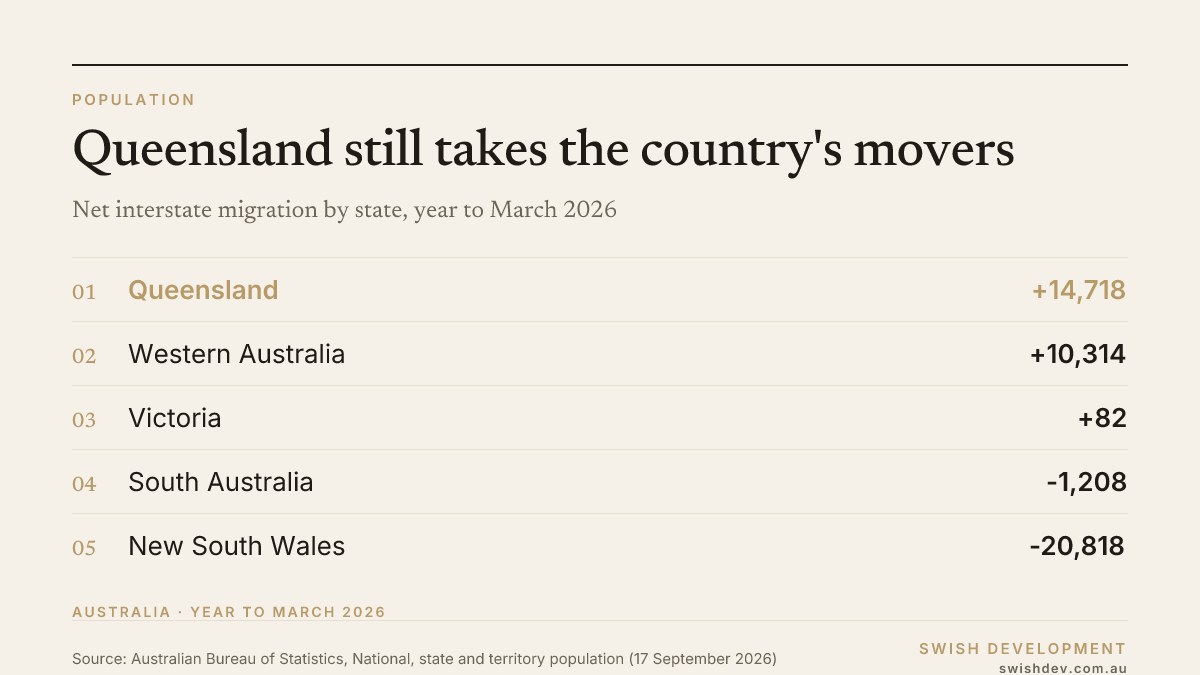
Queensland’s population reached 5,739,500 at 31 March 2026, up 90,100 or 1.6% over the year (ABS, 17 September). Net interstate migration into Queensland was 14,718 for the year, more than any other state. New South Wales lost 20,818 people to other states, Western Australia gained 10,314, and Victoria finished the year at plus 82. Nationally the population reached 27,921,150, growing 392,700 over the year, of which 292,100 was net overseas migration.
The building approvals picture is going the other way. Queensland approved 4,200 dwellings in July, down 13.9% on June in seasonally adjusted terms, while national approvals fell 3.6% on the month and remain 9.0% above a year ago (ABS, released 1 September). The August print lands on 30 September, after this issue.
Auction results through the weekend of 19 September are the weakest local reading in the issue. Brisbane cleared 30.8% of 177 auctions, down from 33.3% the week before and 54.7% at the same point last year. Nationally the rate was 50.6% across 2,086 auctions, against 72.3% on 2,847 auctions a year ago (My Housing Market, 19 September). Volumes are down and the strike rate is down with them.
Brisbane
The More Homes, Sooner changes to Brisbane’s low medium density residential zones took effect on 18 September. We covered the adoption in the issue for w/c 31 August; this is the commencement, and the rules now apply to lodgements. The package cuts minimum lot sizes and moves the zones to a simpler three and four storey framework aimed at duplexes, row houses and low rise apartments (Newsreel, 19 August).
The Mt Gravatt Centre Suburban Renewal Precinct Plan also applies from 18 September, and it runs in the other direction on height. Some areas drop from 12 storeys to 10, interface areas fall from eight storeys to five, and Tenby Street goes from 10 storeys to eight. Upper Mt Gravatt, Stones Corner and Wynnum Centre are the other precincts in the programme, with Alderley, Cannon Hill, Chermside and Sandgate flagged to follow. Lord Mayor Adrian Schrinner framed the combined package as pulling every lever available to council to get more homes built sooner.
Worth reading the two together before assuming the direction of travel in a given suburb. The zone review lifts what is possible across a wide band of ordinary residential land; the precinct plans trim what is possible in specific centres. A site inside a renewal precinct may have less height available this week than it had last week.
Sunshine Coast
Stockland’s duplication of Aura Boulevard moved into its next phase, with the Farmers Crescent to Central Avenue section now progressing (Sunshine Coast News, 17 September). The full project widens 3.5 kilometres from two lanes to four and includes three bridges, with all road and bridge works forecast to finish by mid 2027. The first section, from the Bells Creek Arterial Road roundabout to the Edwards Terrace intersection, started in September 2025.
More than 60,000 vehicles a day now use the wider Caloundra Road corridor, close to double the figure cited about a year earlier. The state is separately planning an east west link between Aura Boulevard and Pelican Waters Boulevard under the $400 million Caloundra Congestion Busting Plan, with no timeframe attached yet.
Access is the constraint that decides whether southern Caloundra land trades at englobo or at lot value, and the mid 2027 completion date is now firm enough to work into a programme.
Moreton Bay
The temporary local planning instrument covering the Morayfield South Emerging Community Area carried a stated expiry of 17 September 2026. Major Planning Scheme Amendment No. 4, which is meant to replace it, completed public consultation on 7 November 2025, and council resolved on 22 April 2026 to notify submitters and ask the Planning Minister to approve the amendment for adoption. Council’s project page still records the amendment as awaiting that approval (City of Moreton Bay).
Morayfield South is the city’s second largest active growth front and is planned for about 9,800 dwellings and 26,000 people. Council has not published what applies in the interval between the instrument’s stated expiry and the Minister’s decision, so anyone with a live application or a settlement conditional on planning outcomes there should confirm the current instrument with council directly rather than assume.
Redland
Redland City Council endorsed its submission on the draft development scheme for the Southern Thornlands Priority Development Area (Redlands Coast Today, 17 September). Submissions on the scheme closed on 15 September, which we flagged last week; this is council’s own position going to the state.
The substance is cost allocation. Council asked that trunk infrastructure be prioritised and delivered at no cost to council, that wastewater upgrades be funded by developers rather than ratepayers, and that further transport modelling be done on Mount Cotton Road, Duncan Road and Boundary Road. The PDA covers 900 hectares and is expected to deliver about 8,000 dwellings and 24,000 residents. Acting Mayor Julie Talty and planning portfolio councillor Rowanne McKenzie carried the position.
A PDA sits under a state development scheme rather than the local City Plan, so the infrastructure charging framework is the live question for anyone modelling a Southern Thornlands parcel. Council has now put on the record that it does not intend to carry the trunk cost.
Somerset
The next round of the Residential Activation Fund put $3.62 million into Kilcoy for roadworks and drainage on Highwood Lane and the D’Aguilar Highway, including dual carriageway upgrades (Mirage News, 14 September). QM Properties says the work immediately enables 189 residential lots in the Hedley Park masterplanned community.
The Kilcoy allocation sits inside a $70 million package announced by Deputy Premier Jarrod Bleijie covering 710 homes across the South Burnett and Somerset, with Kingaroy taking $62.3 million for water and sewer trunk upgrades and Cherbourg $4.1 million.
The number to note is the ratio. A $3.62 million road and drainage job unlocking 189 lots is roughly $19,000 of public money per lot, at the cheap end of what trunk infrastructure costs to solve in the growth corridors. Somerset rarely appears in this section, and the reason it appears now is that small, specific infrastructure gaps are what hold up lot supply in the outer shires.
The resting rate matters more than the next one.
Hauser’s point that rates are near a sensible long run level is the more consequential of Friday’s two messages (ABC, 18 September). A single 25 point move changes a holding cost; a view that 4.35% is closer to normal than to tight changes the discount rate on every project with a 2029 or 2030 completion. Feasibilities still carrying a pre 2022 cost of money as the terminal assumption are modelling a world the Bank has just said is gone.
Investors are the marginal buyer now.
Investors took 35.6% of new lending in the June quarter while owner occupiers gave up 1.72 points of share (APRA, 17 September). Presale campaigns pitched at owner occupier product, priced on owner occupier borrowing capacity, are aiming at the part of the pool that is shrinking. Yield, depreciation and holding cost are doing more of the work in a buying decision than they were a year ago.
Population is holding while approvals fall.
Queensland added 90,100 people in the year to March and drew 14,718 net from other states, more than any state (ABS, 17 September), while Queensland dwelling approvals fell 13.9% in July (ABS, released 1 September). Demand for dwellings is arriving on a schedule that supply is not matching. That gap is the strongest argument for holding land through a soft values period rather than selling into it.
Falling values and falling arrears do not usually travel together.
National values have fallen five months running and sit 3.6% below the March peak (Cotality, 1 September), yet housing arrears improved over the year to June and sit at 0.54% for the 30 to 89 day bucket (APRA, 17 September). Households are servicing debt and declining to transact. That is a liquidity problem in the secondary market, not a credit problem, and it shows up as time on market rather than as distressed stock.
Brisbane auctions are the leading indicator this quarter.
Brisbane cleared 30.8% in the week to 19 September against 54.7% a year ago (My Housing Market, 19 September). Auction clearance moves before median price series do, because a price series only records what settled. Any presale or completed stock campaign launching before Christmas should be planned against the clearance rate, not against a median that still reflects the autumn market.
The consultation calendar is where the next decade gets set.
Southern Thornlands has now had its council submission lodged, Morayfield South is waiting on a ministerial signature, and Queensland’s draft State Planning Policy is open until 26 October. Three separate frameworks that will govern land value across SEQ are being finalised inside six weeks, and the submission windows on two of them have already shut.
Belief has run ahead of capability
The most useful piece of AI research for a small developer this month is not about a tool. Visibuild surveyed 34 general contractors across Australia and New Zealand in May, working on projects between $20 million and $2 billion, including ten of the top fifty contractors in the Hubexo Construction League, and published the results on 19 August. It is a small sample and worth treating as directional, but it covers exactly the tier of builder a small SEQ developer signs with.
The headline gap: 74% of construction leaders believe AI will decide who wins in their market within three years, and 9% think they have the data foundation to act on it. Belief scored 7.9 out of 10 and readiness 4.8. Thirty eight per cent have a data lake and 9% believe it actually works. The report puts 47% of respondents in a category it calls AI theatre, meaning high conviction and low capability, against 38% genuinely building.
The other finding worth noting is that client pressure scored 4.1 out of 10. Nobody is making these builders do this. The push is internal, which usually means it competes for attention with whatever is on site this week.
The practical read is narrow but real. If a head contractor is pitching AI driven programme certainty or cost forecasting in a tender, the base rate says there is roughly a one in ten chance the underlying data is good enough for the claim to mean anything. That is a question worth asking directly at interview: not whether they use AI, but what it reads from, who owns it, and what it predicted on the last job that finished. The answer separates the 38% from the 47%.
28 to 29 September 2026: RBA Monetary Policy Board meets, decision 2:30pm Tuesday 29 September.
30 September 2026: ABS Consumer Price Index and Building Approvals, both for August 2026.
1 October 2026: Cotality Home Value Index for September 2026.
1 October 2026: RBA Financial Stability Review.
7 October 2026: ABS Building Activity, June quarter 2026, covering commencements and completions.
9 October 2026: Narangba East draft Future Directions Report feedback closes.
13 October 2026: NAB Monthly Business Survey, September 2026.
19 October 2026: Ipswich Western Growth Corridor draft structure plan feedback closes.
26 October 2026: Consultation on Queensland’s draft State Planning Policy closes.
3 November 2026: RBA Monetary Policy Board decision and Statement on Monetary Policy.
Subscribe
Not yet on the list?
The SEQ Development Brief lands Tuesday mornings — the big residential development moves across South-East Queensland's twelve councils, plus the occasional update on what we're building. Free.