The SEQ Development Brief
Swish Development
ASIC gives private credit three months
ASIC Commissioner Simone Constant told a Commercial and Asset Finance Brokers Association event in Sydney on 22 September that the regulator had challenged private credit to lift its standards by 2027, “that’s three months away”, and that the sector should now prepare for enforcement action (ABC, 22 September). Her speech says multiple enforcement investigations are under way and that ASIC will publish its surveillance findings within months (ASIC).
Property sits at the centre of it. Constant put real estate at 40 to 60% of Australian private credit, and possibly more, in a sector that has grown about 500% in a decade. She named development lending as exposed to cost escalation, rate rises and unrealistic valuations, and singled out two practices: capitalising interest, and funds that hold illiquid property loans while offering investors regular redemptions.
The review behind the warning covered 28 funds. Four disclosed borrower interest rate information. Fewer than half had detailed written credit and impairment policies. Two wholesale funds stress-tested their liquidity (ABC, 22 September). The case in the background is Bathla, the Sydney developer whose $3.4 billion from more than 40 lenders ran through about 540 special purpose vehicles (ASIC).
ASIC expects every participant to test itself against its 10 private credit principles, which cover governance, valuations, disclosure and stewardship.
For SEQ developers the channel is direct. Non-bank and private credit desks fund a large share of the sites and presale-light projects the major banks decline. A fund told to carry current valuations and disclose capitalised interest will write new construction and land facilities on more conservative terms, and the change is most likely to show up at the next credit approval or refinance rather than in any headline rate.
Unemployment rises into decision day
The unemployment rate rose to 4.6% in August, up 0.2 percentage points, in seasonally adjusted terms (ABS, 24 September). Queensland’s rate rose 0.3 points to 4.5%. Employment still grew, by 39,500 to 14,836,600, and participation lifted 0.2 points to 67.1%, so part of the rise is more people looking for work rather than fewer people in it.
The Reserve Bank Board announces its decision at 2:30pm on Tuesday 29 September. The cash rate is 4.35% after three rises this year, in February, March and May (RBA). CBA expects a 25 basis point rise to 4.60%, and said on 21 September that markets priced a September rise at about 90%, up from about 30% before the July inflation figures (CBA, 21 September). This issue goes out before the announcement and assumes no outcome.
What matters for a sales programme is the combination. A higher cash rate lowers what each buyer can borrow. A softer job market lowers how many buyers are willing to commit. In the week to 24 September both moved against anyone planning to sell presales or completed stock into the December quarter, and HIA’s new home sales figures (below) suggest Queensland buyers had already started pulling back.
Cotality’s August index fell 0.9% nationally, the fifth consecutive monthly decline, leaving values 3.1% lower over the quarter and 2.7% higher over the year (Cotality, 1 September). Brisbane fell 1.0% for the month and 2.7% over the quarter but is still up 10.8% on a year ago, at a median of $1,080,142. Cotality also revised Brisbane’s July result from a 0.6% fall to a 1.2% fall. Regional Queensland fell 0.5% for the month and is up 9.1% over the year.
New home sales are falling faster. HIA’s August figures showed national sales down 10.0% for the month and 7.7% on a year ago, a fourth consecutive fall and the lowest level in more than a year (HIA, 15 September). Queensland sales fell 20.2% over the three months to August against the previous three, the second weakest result after Victoria at 27.0%.
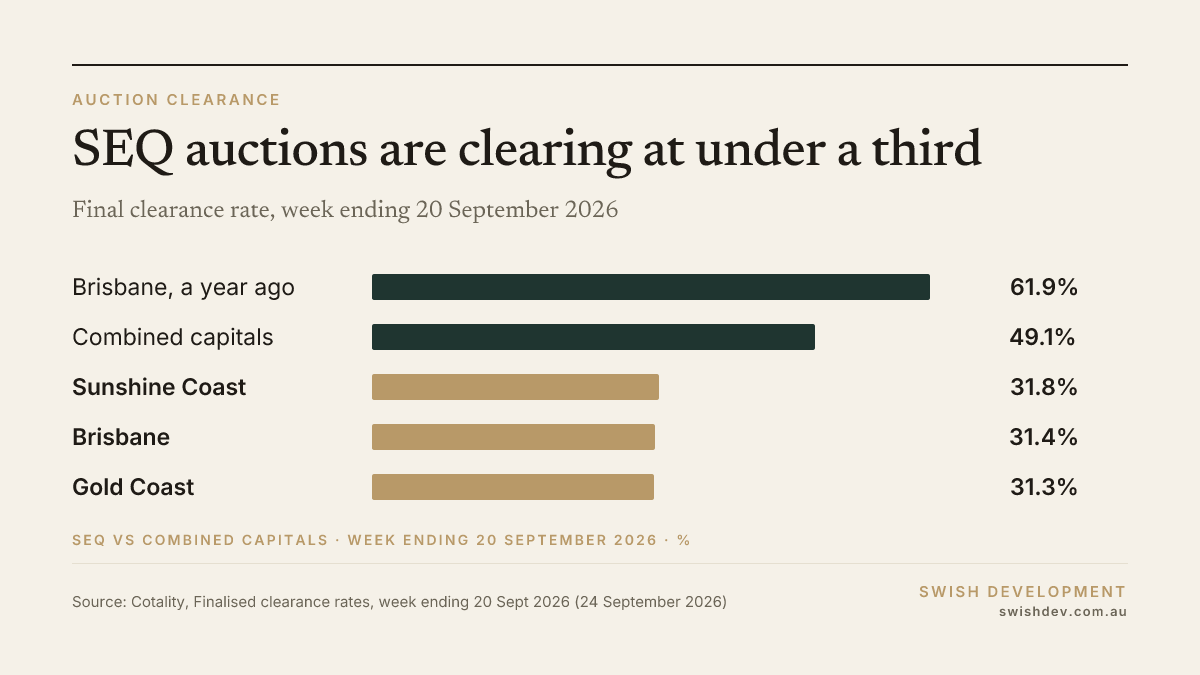
Auction results confirm the local weakness. In the week to 20 September Brisbane had the lowest clearance rate of any capital at 31.4% on 176 auctions, down from 38.5% the week before and 61.9% a year earlier, and its 17th consecutive week below 40% (Cotality). The Gold Coast cleared 31.3% of 48 auctions and the Sunshine Coast 31.8% of 107, against 49.1% across the combined capitals.
August building approvals and the monthly CPI both land on 30 September, and Cotality’s September index on 1 October, all after this issue. The table carries July approvals and the August index.
Brisbane
Deputy Premier Jarrod Bleijie released a proposed amendment to the Bowen Hills Priority Development Area on 17 September that lifts the height limit from 30 to 50 storeys and allows up to 27,000 homes over the life of the PDA, about 4,000 more than the current scheme (Queensland Government, 17 September). The 108 hectare PDA sits beside the Victoria Park precinct, which is planned to hold the new Brisbane Stadium, the National Aquatic Centre and the Showgrounds. Consultation closes on 9 October. The state cites its earlier Woolloongabba amendments as producing a 466% rise in housing development applications within twelve months.
Council approved Shayher Group’s twin towers at 309 North Quay, 56 and 51 storeys with more than 1,100 dwellings on the western edge of the CBD riverfront, designed by Blight Rayner Architecture and Plus Studio (Brisbane Development, 20 September).
On the city’s western edge, Nine Network has listed its 2.54 hectare Mt Coot-tha studio site at 654 Sir Samuel Griffith Drive, with expressions of interest through Savills closing on 28 October (The Urban Developer, 25 September). The site sits under the Mt Coot-tha Neighbourhood Plan, which is aimed at eco-tourism, so any residential repositioning would need an approval the plan does not currently point toward.
Gold Coast
Homecorp started construction on Lýon Residences at Budds Beach in Surfers Paradise, a $360 million, 32 storey building with 178 apartments priced from $1.6 million (Brisbane Development, 20 September). City of Gold Coast approved the scheme on 19 June under MCU/2026/72, and it grew from 27 storeys and 156 units during assessment.
Sunshine Coast
Sunshine Coast Airport has lodged a draft masterplan with Economic Development Queensland for a 34 hectare Airport North Precinct on the decommissioned runway beside Marcoola, valued at $75 million (The Urban Developer, 25 September). Proposed uses include a resort and hotel, short-term accommodation, multiple residences, a retirement facility, retail and health services. Aviation requirements generally hold buildings to 10 storeys.
The site sits inside the 460 hectare Sunshine Coast Airport PDA declared in 2023, so EDQ assesses the application and Sunshine Coast Council does not. Public notification of 20 business days has not yet started. Councillor Taylor Bunnag has opposed the plan, citing stretched infrastructure and the loss of land for aviation uses (ABC, 23 September). No dwelling count has been published.
Redland
A federal environmental assessment is open on Sutgold Pty Ltd’s residential subdivision at Double Jump Road, Victoria Point, under EPBC reference 2024/09825 (Redlands2030, 27 September). Project documentation describes 240 single dwelling lots, two medium density areas and a small commercial area, clearing 32.57 hectares or 86.2% of the project area and 1,054 koala habitat trees. Proposed offsets total 113.84 hectares at Woolshed and Thagoona near Ipswich. Comments close on 2 October.
The project is being assessed on preliminary documentation, a lighter track than a full environmental impact statement. For anyone holding koala habitat land in the Redland growth areas, the offset ratio and location here are a working reference for what the Commonwealth may accept.
Private lenders will reprice before banks.
ASIC wants current valuations, disclosure of capitalised interest and liquidity stress testing, and says enforcement investigations are already running (ASIC, 22 September). Every one of those pushes a fund toward lower LVRs and less capitalised interest on new development loans. A feasibility that assumes last year’s non-bank terms at the next refinance is carrying a risk the regulator has just described in public.
The buyer pool is thinning on two fronts.
Unemployment rose to 4.6% nationally and 4.5% in Queensland in August (ABS, 24 September), in the same week CBA forecast a rise to 4.60% (CBA, 21 September). Queensland new home sales were already down 20.2% over three months (HIA, 15 September). A presale target set in autumn is being tested against fewer buyers who can each borrow less.
Approvals today meet the 2027 buyer.
HIA says the fall in new home sales means a housing slowdown is now set for 2027 (HIA, 15 September). A project approved this quarter reaches completion in that year. The sales risk sits at completion, so the useful question on a new site is how the numbers look if settlement values in 2027 come in below today’s.
The biggest yield lifts are coming through PDAs.
Bowen Hills is proposed to go from 30 to 50 storeys under a state PDA scheme (Queensland Government, 17 September), the state credits its Woolloongabba PDA amendments with a 466% rise in housing applications, and the Sunshine Coast Airport precinct is being assessed by EDQ rather than council. The state is using PDAs to move density faster than a council scheme amendment can. Land inside or beside a PDA boundary is where the planning upside is being priced first, and where the local objections carry least weight in the decision.
The DA desk is next
Brisbane City Council’s tender for an “AI enabled Development Application Support Solution”, run under its Faster Smarter Approvals programme, closed on 24 September after opening on 1 July (AustralianTenders, reference CW29217). There is no contract value, no vendor and no council announcement yet, so this is a council shopping for a tool rather than launching one. It is still the clearest sign that Australia’s largest council expects machines to read part of its DA intake.
The closest working model is in Toronto. On 31 August the city launched a building permit pre-check on Clariti’s CivCheck platform, which flags missing documents and some zoning and building code issues before lodgement and cites the rule behind each flag (PR Newswire, 31 August). It cannot approve, refuse or delay a permit. In Honolulu’s earlier use, residential permits that went through the tool reached a decision 55% faster, saving applicants more than 40 days on average.
Those savings come from fewer information requests, not faster judgement. That is where a small developer’s holding cost is spent: the weeks between lodgement and the first request for information, and the weeks answering it. If Brisbane’s tool works like Toronto’s, the gain goes to applicants whose documents are already complete and consistent. The consultant team that assembles a clean, cross-checked lodgement pack will matter more, and the one that relies on the assessment officer to spot gaps will cost more time than it does now.
30 September 2026: ABS monthly CPI and Building Approvals, both for August 2026.
1 October 2026: RBA Financial Stability Review.
1 October 2026: Cotality Home Value Index for September 2026 (expected).
2 October 2026: Public comment closes on the Double Jump Road, Victoria Point EPBC assessment.
5 October 2026: Feedback closes on the Holmview station redesign, Logan and Gold Coast Faster Rail.
7 October 2026: ABS Building Activity, June quarter 2026.
9 October 2026: Consultation closes on the Bowen Hills PDA amendment, and Narangba East Future Directions Report feedback closes.
13 October 2026: Minutes of the September RBA meeting.
15 October 2026: ABS Labour Force, September 2026.
19 October 2026: Ipswich Western Growth Corridor draft structure plan feedback closes.
26 October 2026: Consultation on Queensland’s draft State Planning Policy closes.
28 October 2026: ABS CPI, September 2026 quarterly figures.
3 November 2026: RBA Monetary Policy Board decision and Statement on Monetary Policy.
11 November 2026: ABS Lending Indicators, September quarter 2026.
Subscribe
Not yet on the list?
The SEQ Development Brief lands Tuesday mornings — the big residential development moves across South-East Queensland's twelve councils, plus the occasional update on what we're building. Free.