The SEQ Development Brief
Swish Development
Brisbane leads the capitals down
Brisbane dwelling values fell 1.5% in September, the largest monthly fall of any capital and ahead of Sydney’s 1.4% (Cotality, 1 October). Values are down 4.7% over the quarter and 5.4% below their May peak, with the median at $1,048,880. The annual figure is still positive at 5.9%, and that gap between the year and the quarter is the turn in a single number.
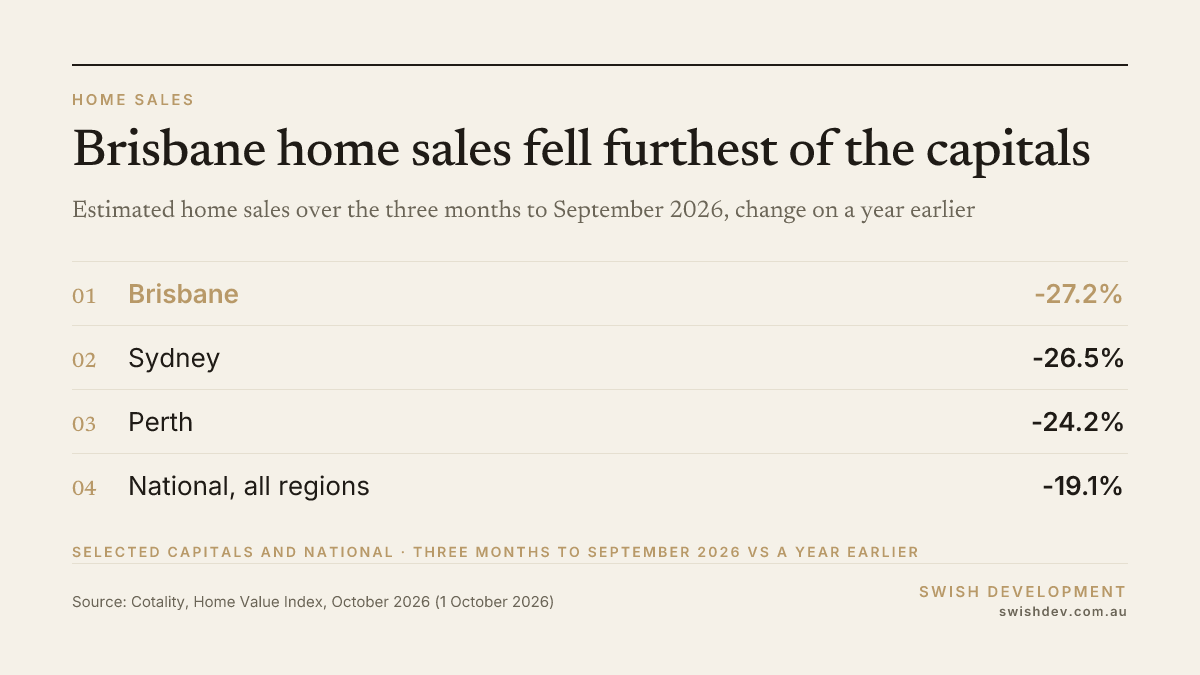
The sharper signal is volume. Cotality estimates home sales over the three months to September were 27.2% lower than a year earlier in Brisbane, the biggest drop of any capital, against 19.1% nationally. Across the combined capitals new listings were 9.2% lower than a year ago, yet total inventory was 23.1% higher, because homes are taking a median of 39 days to sell against 23 days a year ago.
Nationally, values fell 1.1%, the sixth monthly fall in a row, and are 5.2% below the March peak. Cotality’s research director Tim Lawless said 97% of capital city suburbs fell in value over the three months to September. Regional Queensland held up better, down 0.9% for the month and still 6.3% higher over the year.
For a developer, the volume figure matters more than the price figure. A presale programme or a completed-stock campaign depends on how many buyers transact each month, and in Brisbane that count has fallen by more than a quarter in a year.
The RBA lifts to 4.60%, then inflation hits 4.0%
The Reserve Bank Board raised the cash rate by 25 basis points to 4.60% on 29 September, in a unanimous decision (RBA, 29 September). It is the fourth rise this year, after February, March and May. The Board said inflation remains elevated and that “some of the upside risks flagged in August are materialising”, noted that housing prices have fallen in most capital cities and new housing loans have “declined noticeably”, and said it would raise the rate further if needed.
The next morning the ABS confirmed the call. Annual CPI inflation rose to 4.0% in August from 3.5% in July, with trimmed mean inflation steady at 3.6% (ABS, 30 September). Housing was up 5.7% over the year, new dwelling prices 5.4% and rents 3.6%. Brisbane’s all-groups figure was 4.1%.
Banks are passing the rise through. CBA lifted its business variable base rates, including the commercial variable base rate and overdraft reference rates, by 0.25 percentage points from 9 October (CBA, 30 September). Any development, land or bridging facility priced off those rates costs more from next week.
Queensland approvals fall 22.5%
Queensland dwelling approvals fell 22.5% in August to 3,327 in seasonally adjusted terms, the largest fall of any state (ABS, 30 September). Private house approvals in Queensland rose 6.5% to 2,456, so almost all of the fall came from everything other than detached houses, which made up about 870 approvals.
Nationally the pattern was the same. Total approvals fell 6.1% to 16,953, with private houses up 3.7% to 10,885 and private dwellings excluding houses down 21.2% to 5,674. Monthly apartment approvals are volatile, and the national trend series fell a more modest 0.8%. Even so, a monthly fall of this size in Queensland has come in the same quarter that values turned and rates rose.
The September HVI shows the market losing turnover faster than it is losing value. Combined capitals values fell 1.2% for the month and 1.8% over the year, while regional markets fell 0.7% and remain 5.6% higher over the year (Cotality, 1 October). The national rental vacancy rate rose to 2.0%, its highest since January 2025, with Brisbane at 2.1%. Gross rental yields lifted to 3.85% nationally, the highest since August 2019, though Brisbane’s sits at 3.5%.
Brisbane auctions recovered a little on a thin week. The preliminary clearance rate rose 5.1 points to 42.6% on 144 auctions in the week to 27 September (Cotality, 28 September), against 50.3% across the combined capitals, the lowest result in ten weeks. These are preliminary figures and can be revised once late results come in.
Unemployment for September lands on 15 October and September-quarter CPI on 28 October, both after this issue. The table carries August labour force figures.
Private credit meets its first freeze
Metrics Credit Partners, which manages about $40 billion, suspended redemptions on 30 September in two unlisted funds: the $6 billion MCP Wholesale Investment Trust and the $3.3 billion Wholesale Real Estate Debt Fund (MPA, 30 September). Auditor KPMG had declined to sign off the full-year accounts, disagreeing with assumptions including how fair value was calculated for unlisted commercial real estate equity investments (Reuters, 30 September). The ASX suspended Metrics’ three listed trusts, whose net tangible asset values were cut by about $168 million in total, including more than 12% off the Real Estate Multi-Strategy Fund. Metrics says it has no direct exposure to Bathla. ASIC said it was monitoring and that firms restricting redemptions must act in investors’ best interests.
The Reserve Bank’s Financial Stability Review, out the next day, put this in context (RBA, 1 October). It says Australian private credit funds are “typically concentrated in real estate lending, including for construction and development”, that a developer insolvency has “tightened funding conditions for some Australian funds”, and that some non-bank lenders report “a moderation in lending competition more recently, particularly for higher-risk projects”. It says this may affect access to funding for “some residential property developers”. It also judges that private credit is too small, at around 10% of business debt, to pose a system-wide risk.
Read together, the two releases describe the same thing from different ends. Funds facing redemption pressure hold back new commitments, and the projects they hold back on first are the ones banks already decline: land banking, early works, presale-light construction. A developer with a facility due for renewal in the next six months should expect its non-bank lender to ask harder questions about valuations and capitalised interest, and should price in the CBA-style base rate rise from 9 October on bank facilities as well. This is a read of market conditions, not advice on any lender or product.
Brisbane
IFM Investors lodged a development application on 30 September for its Regent Lane precinct at 150 Elizabeth Street, the third redesign of the Wintergarden site (Brisbane Development, 2 October). The Woods Bagot scheme has two towers: a hotel and residential tower with 290 apartments and a 240-room hotel, and a commercial tower, with 24,607 square metres of office space and 7,384 square metres of retail on a 7,260 square metre site. The Regent Theatre facade, entrance hall and foyer are retained, and the project is staged in three parts (A007121657).
The state named a BESIX Watpac and John Holland joint venture as builder for the $3.6 to $3.8 billion Victoria Park stadium, ahead of Built and SACYR (The Urban Developer, 30 September). The 63,000-seat stadium starts construction in 2027, adding another tier-one project to the same contractor pool that residential builders draw on.
Gold Coast
City of Gold Coast’s interim LGIP amendment commenced on 29 September as City Plan Version 14, after adoption on 28 July (City of Gold Coast). It moves the planning horizon to 2024 to 2041 and updates demand projections, trunk infrastructure plans, service standards and the financial model behind infrastructure charges. Anyone pricing Gold Coast land should check trunk infrastructure assumptions and offsets against the new version rather than the old one.
Council approved Sunland’s 101 OBR Residences at 99 to 101 Old Burleigh Road, Broadbeach: 42 storeys, 81 apartments and $390 million on a 1,283 square metre site, with construction from early 2027 and completion in mid-2031 (The Urban Developer, 29 September).
Sunshine Coast
ARM Property Investment Group has started work on 162 rooming accommodation units in two eight-storey buildings at the corner of Currie and Bury streets in Nambour, aimed at hospital and infrastructure workers and others priced out of the coast’s housing market, with opening expected by 2028 (Sunshine Coast News, 2 October). Rooming accommodation trades unit size and private facilities for a lower entry price.
Logan
Logan City Council holds a special meeting at 2pm on 6 October, the send day of this issue, to consider a temporary local planning instrument on flood mapping (Logan City Council, 1 October). It would limit the flood overlay to the 1% annual exceedance probability event, removing rarer events including the probable maximum flood, and create a Flood Planning Area 1 that allows open structures such as carports. Mayor Jon Raven said the number of properties in the overlay would fall by 56.8%. The instrument needs state approval, with implementation expected in early 2027.
Moreton Bay
A catch-up item: Moreton Bay’s LGIP Amendment No. 2 was adopted on 9 September and took effect on 11 September, updating trunk infrastructure planning carried out since December 2021 (City of Moreton Bay). The public notice gives no detail on charge rates.
Absorption is now the number to stress.
Brisbane values are down 4.7% over the quarter, but sales are down 27.2% on a year ago and capital city homes take 39 days to sell against 23 (Cotality, 1 October). A feasibility that runs a price sensitivity but keeps last year’s sales rate is testing the smaller risk. Holding costs on unsold stock, now at a higher cash rate, are where the margin goes.
Build costs and sale prices are moving in opposite directions.
New dwelling prices are up 5.4% over the year (ABS, 30 September) while Brisbane values fell 4.7% in three months (Cotality, 1 October). Contracts signed this year carry the first number and settlements next year carry the second. Fixed-price build contracts and staged releases matter more than they did six months ago.
The apartment pipeline is thinning now, and that shows up later.
Queensland approvals for dwellings other than private houses fell to about 870 in August, while house approvals rose (ABS, 30 September). Projects that drop out at approval stage in 2026 are completions that do not arrive in 2028 and 2029. A developer with an approved, funded medium-density site is holding something the market is currently creating less of.
Rising yields do not rescue develop-and-hold.
Brisbane’s gross rental yield is 3.5% and vacancy has risen to 2.1% (Cotality, 1 October), against a cash rate of 4.60%. National rents are still growing, but at the slowest monthly pace since May 2025. Holding finished stock as rentals while the sales market recovers carries a negative cash flow for most projects at current debt costs.
Overlay and charge changes can move land values faster than prices do.
Logan’s proposed flood instrument would take 56.8% of overlay-affected properties out of the mapping (Logan City Council, 1 October), and the Gold Coast’s updated LGIP took effect on 29 September. For sites near flood lines or at the edge of trunk networks, these documents change what can be built and what it costs. They deserve a check before any offer.
Data centres are borrowing from the same pool
The Reserve Bank’s Financial Stability Review includes a passage on artificial intelligence infrastructure (RBA, 1 October). It says investment in data centre construction in Australia “has picked up strongly over recent years, mainly funded by debt”, driven by demand from global hyperscalers, and financed mostly through syndicated loans involving private equity firms and domestic and foreign banks. Its warning is that the reliance on debt and rapid growth “could introduce some vulnerability to the broader financial system over time”.
The Commonwealth is moving on the planning side at the same time. Its consultation paper, Getting it right: Building AI infrastructure that works for Australia, proposes mandatory national standards on energy, water and land use for data centres of 30MW and above, with heavier requirements above 100MW, and asks how they would sit alongside state planning approvals (Clayton Utz, 29 September). Submissions close at 5pm AEDT on 9 October, and the government intends to legislate in early 2027.
The point for an SEQ developer is competition for capital and contractors rather than technology. Banks lending to hyperscale construction are allocating balance sheet and construction risk appetite to the same sector that funds residential projects, and data centre builds draw on the same electrical and civil trades. In the week a residential-focused private credit manager froze $9.3 billion of redemptions, the RBA’s description of data centre debt as “rapidly growing” is a reminder of where lenders are finding the growth they are no longer chasing in housing.
7 October 2026: ABS Building Activity, June quarter 2026.
9 October 2026: Consultation closes on the Bowen Hills PDA amendment; Narangba East Future Directions feedback closes.
9 October 2026: Submissions close on the Commonwealth data centre standards paper, 5pm AEDT; CBA business variable rate rises take effect.
13 October 2026: Minutes of the September RBA meeting.
15 October 2026: ABS Labour Force, September 2026.
19 October 2026: Ipswich Western Growth Corridor draft structure plan feedback closes.
26 October 2026: Consultation on Queensland’s draft State Planning Policy closes.
28 October 2026: ABS CPI, September quarter; Halls Creek PDA submissions close; Nine Mt Coot-tha EOIs close.
2 November 2026: Cotality Home Value Index for October 2026 (expected).
3 November 2026: RBA Monetary Policy Board decision and Statement on Monetary Policy.
11 November 2026: ABS Lending Indicators, September quarter 2026.
Subscribe
Not yet on the list?
The SEQ Development Brief lands Tuesday mornings — the big residential development moves across South-East Queensland's twelve councils, plus the occasional update on what we're building. Free.